
Navigating the complex world of cryptocurrency trading requires more than just an understanding of when to buy or sell. As markets mature and volatility remains a constant companion, traders increasingly rely on sophisticated order strategies to manage risk and capitalize on opportunities without constant monitoring. Basic market orders, which execute immediately at current prices, often fail to provide the precision needed for professional-grade strategies.
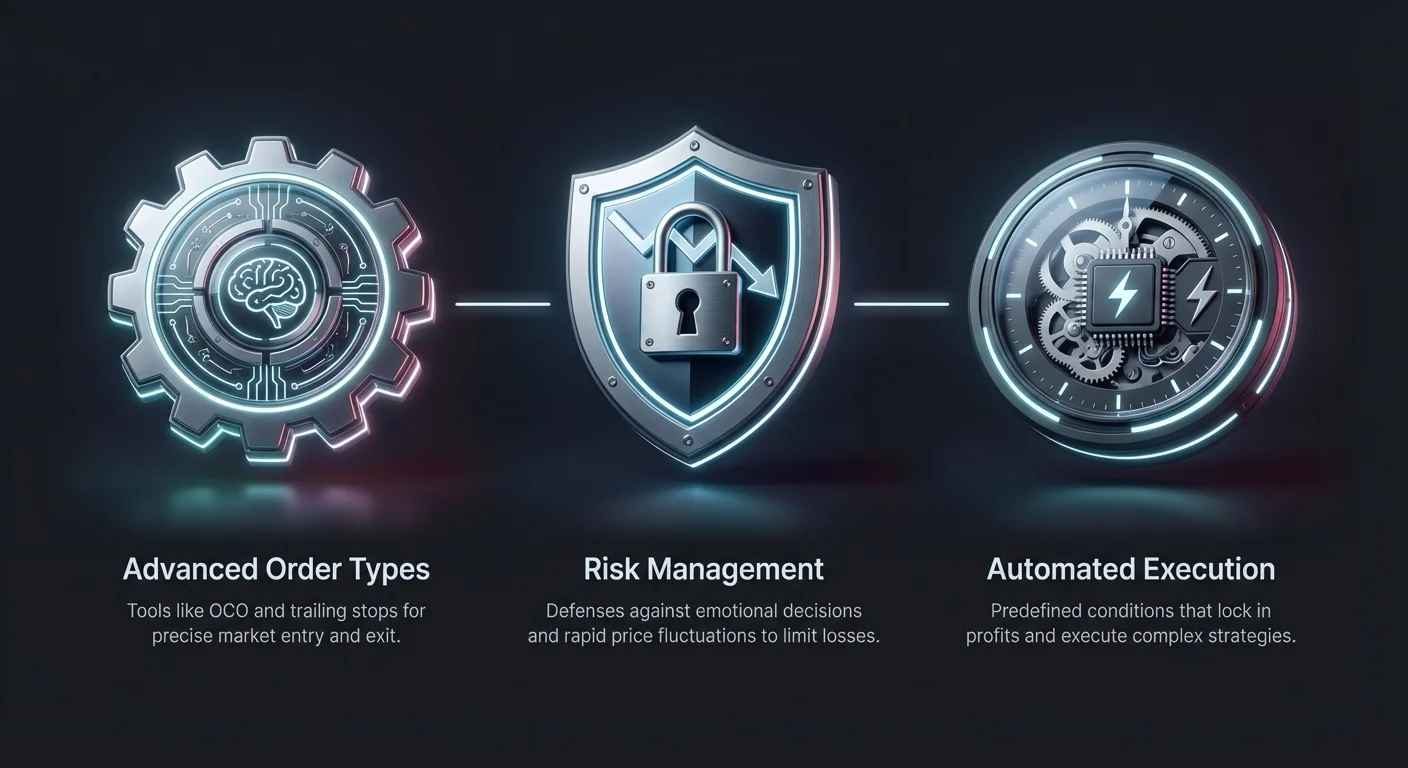
Advanced order types such as One Cancels the Other (OCO), trailing stops, and grid trading mechanisms allow market participants to automate their entry and exit points. These tools serve as a defense against emotional decision-making and rapid price fluctuations that characterize the digital asset space. By setting predefined conditions, traders can lock in profits, limit losses, and execute complex strategies that would be impossible to perform manually in real-time.
The Fundamentals of Advanced Order Types
Moving Beyond Market Execution
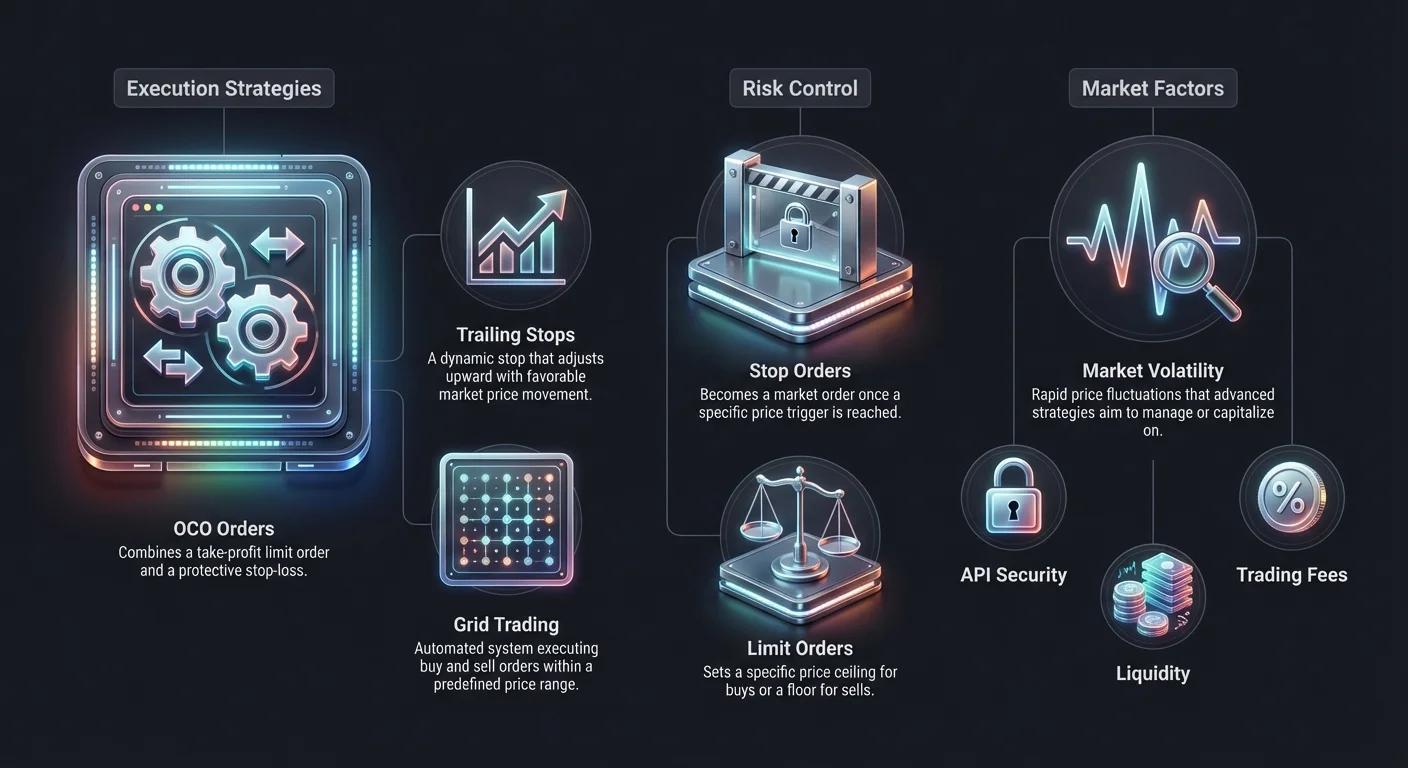
The simplest form of trading involves market orders, where a trader accepts the current price to ensure immediate execution. While effective for speed, this method exposes the trader to slippage, especially during periods of high volatility or low liquidity. Advanced traders prefer limit orders, which set a specific price ceiling for buys or a price floor for sells. This ensures price certainty but introduces the risk that the order may never fill if the market moves away from the target price.
The Logic of Conditional Orders
Conditional orders introduce "if-then" logic to the trading environment. These orders remain dormant until a specific trigger price is reached. Stop orders are the most common variety, becoming market orders once a specific price level is hit. These are crucial for risk management using tools like ATR, acting as a safety net to prevent catastrophic losses during a market crash. More complex variations combine these triggers with limit orders to ensure that execution only happens within a specific price range, protecting the trader from paying too much during a breakout.
Strategic Implementation in Volatile Markets
In a 24/7 market environment, advanced orders act as a proxy for the trader's presence. They allow for strategy execution during sleep or times when active monitoring is impossible. For instance, a stop-limit order can protect a long position while the trader is away, ensuring that if support levels break, the asset is sold before losses compound. Conversely, buy-stop orders can be placed above resistance levels to automatically enter a trade only if a bullish breakout is confirmed by price action.
Mastering One Cancels the Other (OCO) Strategies
defining the OCO Mechanism
A One Cancels the Other (OCO) order is a powerful tool that combines two separate orders—typically a limit order and a stop order—into a single automated strategy. The defining characteristic of an OCO setup is the conditional link between the two components. If either the limit order or the stop order is executed, the trading engine automatically cancels the remaining order. This duality allows traders to set both a profit target and a protective stop-loss simultaneously.
Practical Application of OCO
Consider a scenario where a trader holds Bitcoin valued at $60,000. They might wish to sell if the price reaches $65,000 to secure a profit, but also want to sell if the price drops to $58,000 to prevent further loss. Without an OCO order, placing both a sell limit and a sell stop would require locking up double the assets or risking manual cancellation errors. With an OCO order, the trader sets both parameters. The moment $65,000 is hit, the profit is taken, and the $58,000 stop is instantly removed.
Platforms Supporting OCO Functionality
Support for OCO orders is a hallmark of robust trading platforms. Exchanges like BTCC have integrated this functionality to help users maximize trading strategies while navigating their user-friendly interfaces. By offering OCO alongside standard market and limit orders, platforms cater to traders who require strict risk management protocols. This feature is particularly valuable in leverage trading, where price swings can impact account balances rapidly, necessitating precise automated exits.
| Order Component | Purpose | Execution Logic |
|---|---|---|
| Limit Order | Take Profit | Executes at a better price than market |
| Stop Order | Stop Loss | Triggers when price moves against position |
| Linkage | Automation | Filling one cancels the other immediately |
The Dynamic Protection of Trailing Stops
Trailing stops represent a significant evolution in risk management orders. Unlike a static stop-loss that remains fixed at a specific price level, a trailing stop follows the market price as it moves in a favorable direction. If a trader enters a long position and the asset price rises, the trailing stop adjusts upward, maintaining a set distance or percentage from the current market price. This dynamic nature allows traders to secure gains as a rally continues, rather than exiting too early or giving back profits during a reversal.
The primary advantage of a trailing stop is its ability to remove the emotional difficulty of deciding when to move a stop-loss manually. Uphold is a notable platform that supports this advanced feature, offering tools like Trailing Stop alongside Take Profit and Limit Orders. By utilizing a trailing stop, a trader on a platform like Uphold can effectively "let winners run" while retaining a safety net that tightens automatically. If the market reverses by the specified percentage, the order triggers, closing the position and preserving the accumulated profit.
Automating Volatility with Grid Trading
The Mechanics of Grid Strategies
Grid trading is a systematic approach that capitalizes on normal market volatility rather than predicting a specific trend direction. This strategy involves placing a series of buy and sell orders at predetermined price intervals, creating a "grid" of orders above and below the current market price. As the market fluctuates within this range, the system automatically executes buy orders when prices dip and sell orders when prices rise. This automation is particularly effective in sideways or ranging markets where assets oscillate between support and resistance levels without establishing a clear long-term trend.
Benefits of Automated Grid Execution
The primary benefit of grid trading is its ability to remove human emotion and fatigue from the equation. Crypto markets operate continuously, and manual execution of high-frequency scalping trades is physically impossible for a human trader to sustain. Grid trading bots run 24/7, capturing small profits from minor price movements that would otherwise be missed. This method generates passive activity in a portfolio, accumulating gains through repetitive, small-margin trades.
Customization and Risk Control
Successful grid trading requires careful parameter setting. Traders must define the upper and lower limits of the grid, the number of grid lines (intervals), and the capital allocated to the strategy. Platforms supporting grid trading allow users to adjust these settings based on asset volatility. A wider grid is often used for highly volatile assets to prevent the price from exiting the range too quickly, while a narrower grid suits stable assets to capture frequent, small fluctuations.
| Feature | Grid Trading | Traditional Holding |
|---|---|---|
| Market Condition | Sideways/Ranging | Bullish Trend |
| Activity Level | High (Automated) | Low (Passive) |
| Profit Source | Volatility/Oscillation | Long-term Appreciation |
Platform Ecosystems: Gemini and High-Speed Execution
The ActiveTrader Interface
For traders demanding professional-grade tools, Gemini offers the ActiveTrader interface. This platform is distinct from standard exchange interfaces, designed specifically for sophisticated participants who require advanced charting and multiple order types. ActiveTrader facilitates high-speed execution, capable of processing trades in microseconds. This speed is critical when utilizing advanced strategies that rely on precise entry points and rapid order fulfillment, a prerequisite for high-frequency scalping.
Regulatory Compliance and Security
Gemini differentiates itself through a strong commitment to compliance and security, factors that are crucial for institutional and high-volume traders. The platform operates as a full-reserve exchange and custodian, ensuring that all assets are backed one-to-one. For traders employing complex strategies involving significant capital, the assurance of regulatory oversight by bodies like the New York Department of Financial Services adds a layer of confidence necessary for executing large-scale advanced orders.
Platform Ecosystems: Kraken and Leverage
Comprehensive Asset Selection
Kraken provides a robust environment for advanced trading strategies, supported by high liquidity and a vast selection of cryptocurrencies. The platform's architecture supports multi-chain trading, allowing users to diversify portfolios across different blockchain ecosystems. This diversity is essential for traders who utilize advanced orders not just on Bitcoin, but across a spectrum of altcoins and emerging tokens.
Margin and Futures Capabilities
Advanced strategies often involve the use of leverage to amplify potential returns. Kraken supports margin and futures trading, enabling users to borrow funds to trade larger positions than their account balance would essentially permit. While this increases risk, the availability of advanced order types on the platform helps manage this exposure. Traders can employ stop orders and take-profit mechanisms within their margin positions to enforce strict risk parameters.
Copy Trading as an Advanced Strategy
Replicating Expert Execution
Copy trading has emerged as a unique strategy that allows less experienced traders to leverage the advanced order management of seasoned professionals. Platforms like Bitget and PrimeXBT have integrated copy trading features directly into their exchanges. This functionality enables a user to automatically mirror the trades of top-performing investors. When the expert executes a complex OCO order or a grid strategy, the follower's account replicates the action proportionally.
Diversification Through Mimicry
By following multiple traders with different strategies, a user can effectively diversify their portfolio. One expert might focus on high-frequency scalping using grid bots, while another might employ swing trading with trailing stops. Bitget’s platform supports a wide range of cryptocurrencies, allowing copy traders to follow strategies that span Bitcoin, Ethereum, and numerous altcoins. This approach democratizes access to advanced trading logic without requiring the user to master the technical implementation of every order type.
Diversifying with Tokenized Stocks
Bridging Traditional and Crypto Markets
The concept of advanced order strategies extends beyond pure cryptocurrencies into the realm of tokenized stocks. Platforms are increasingly offering digital representations of traditional equities, allowing users to trade shares of companies like Apple or Tesla using Bitcoin or stablecoins. This innovation provides crypto traders with access to traditional financial markets without the need for a separate brokerage account.
24/7 Market Access
One of the distinct advantages of trading tokenized stocks on crypto exchanges is the potential for 24/7 trading availability, depending on the platform's infrastructure. Unlike traditional stock markets with rigid opening and closing bells, tokenized assets often offer greater flexibility. Traders can apply their crypto-native strategies—such as automated grid trading or trailing stops—to these equity tokens, managing their exposure to traditional market sectors using the same interface they use for digital assets.
Liquidity and Trade Execution
The Importance of Volume
For any advanced order strategy to function correctly, the underlying platform must possess sufficient liquidity. Liquidity refers to the ease with which an asset can be bought or sold without causing a significant change in its price. High liquidity ensures that stop orders are filled near their trigger prices and that limit orders are executed promptly when the market reaches the target.
Mitigating Slippage
Slippage occurs when an order is filled at a price different from the expected price, often due to a lack of available counterparties at the specific price level. In day trading environments, slippage can erode the profit margins of tight scalping strategies. Platforms with deep liquidity and active trading communities minimize this risk. When choosing an exchange for strategies like grid trading, which executes numerous trades, volume is a critical factor to ensure that the theoretical profits of the grid are realized in actual execution.
| Factor | Impact on Strategy | Solution |
|---|---|---|
| Low Liquidity | High Slippage | Choose high-volume exchanges |
| Volatility | Gap Risk | Use OCO/Limit orders |
| Spread | Cost Inefficiency | Trade tight-spread pairs |
Analyzing Fee Structures for Strategy Optimization
The Impact of Trading Fees
Trading fees are a decisive factor in the profitability of advanced strategies, particularly those involving high-frequency execution like grid trading. Fees are typically categorized into maker fees and taker fees. Makers provide liquidity to the order book by placing limit orders that do not fill immediately, while takers remove liquidity by executing market orders. Exchanges often incentivize makers with lower fees to ensure a healthy order book.
Fee Tiers and Strategy Selection
Advanced traders must analyze the fee schedule of their chosen platform. Some exchanges offer volume-based discounts or reduced fees for holding the platform's native token. For strategies that involve hundreds of trades per week, even a small difference in percentage fees can significantly impact the net outcome. Zero-fee trading promotions on specific pairs can be highly advantageous for testing new automated strategies without incurring overhead costs.
Withdrawal and Hidden Costs
Beyond execution fees, traders must consider withdrawal fees and spread costs. Some platforms may advertise low trading fees but compensate with wider spreads between buy and sell prices, effectively acting as a hidden cost. Efficient fund management requires a holistic view of all costs associated with the exchange, ensuring that the expense of executing complex orders does not outweigh the strategic benefits.
Lending and Passive Yield
Earning on Idle Assets
Advanced trading is not solely about active buying and selling; it also involves efficient capital allocation. During periods of market consolidation, or while waiting for deep limit orders to fill, capital can remain unproductive. Crypto lending platforms allow traders to earn interest on these idle assets. By depositing funds into savings accounts or lending pools, traders can generate a passive yield that supplements their trading income.
Collateralization and Liquidity Access
Lending platforms also enable traders to access liquidity without selling their long-term holdings. By using Bitcoin or other assets as collateral, a trader can take out a crypto loan to fund short-term trading strategies or cover margin requirements. This flexibility allows for the execution of advanced strategies without triggering taxable events associated with selling the underlying asset. Platforms offering competitive loan-to-value (LTV) ratios provide the necessary leverage to maximize capital efficiency.
Instant Swap Platforms vs. Order Books
The Role of Swap Platforms
While advanced order books are essential for precise strategies, instant swap platforms serve a different purpose. These non-custodial services facilitate rapid exchange between different cryptocurrencies without the complexity of charts or order types. Platforms like ChangeNOW and CCE Cash focus on speed and simplicity, often requiring no account registration.
Strategic Utility of Swaps
Swap platforms are useful for rebalancing portfolios quickly or moving into a new asset class to capitalize on a sudden trend. They eliminate the need to manage bid-ask spreads manually, providing a fixed or floating rate for the conversion. For traders who identify a macroeconomic shift and wish to rotate capital immediately, the simplicity of a swap platform complements the precision of an order-book exchange.
Security Considerations for Automated Trading
API Security
Implementing advanced strategies like grid trading often involves the use of trading bots or third-party software that interacts with the exchange via an Application Programming Interface (API). Securing these API keys is paramount for managing automated trading risks. Traders should configure permissions strictly, allowing the API to execute trades but disabling withdrawal capabilities. This ensures that even if the API key is compromised, the funds cannot be removed from the exchange account.
Exchange Security Protocols
The security of the platform itself is the foundation of any strategy. Reputable exchanges employ cold storage for the majority of user funds, keeping them offline and inaccessible to hackers. Two-factor authentication (2FA) adds a critical layer of defense against unauthorized access. Platforms that undergo regular security audits and maintain regulatory compliance offer a safer environment for deploying long-term automated strategies.
Custodial vs. Non-Custodial Risks
Traders must weigh the convenience of centralized exchanges (CEX) against the control of decentralized exchanges (DEX). Centralized platforms typically offer superior liquidity and advanced order types like OCO and trailing stops natively. However, they require trusting the custodian with funds. Decentralized platforms reduce counterparty risk but may lack the advanced order functionality and speed required for certain high-frequency strategies.
The Importance of Educational Resources
Continuous Learning
The crypto market evolves rapidly, and staying informed is essential for maintaining a competitive edge. Top-tier exchanges invest heavily in educational resources, providing tutorials, articles, and guides on how to utilize their advanced features effectively. Platforms like Coinbase offer incentives for learning, rewarding users with crypto for completing educational modules.
Understanding Market Mechanics
Effective use of advanced orders requires a deep understanding of market mechanics. Traders must comprehend concepts such as support and resistance, liquidity voids, and market depth. Educational tools provided by exchanges help bridge the gap between basic knowledge and professional application. By mastering these concepts, traders can configure their OCO orders and grid parameters with greater precision, aligning their automated strategies with the underlying market structure.
Conclusion
The integration of advanced order strategies into a crypto trading plan marks the transition from reactive participation to proactive management. Tools like OCO orders, trailing stops, and grid trading bots provide the necessary infrastructure to navigate volatile markets with precision and discipline. By utilizing platforms that support these features, traders can enforce strict risk management rules, automate profit-taking, and capitalize on market inefficiencies that would be impossible to catch manually.
Selecting the right exchange is a foundational step in this process. Whether prioritizing the high-speed execution of Gemini, the leverage options of Kraken, or the automated solutions of Bitget and BTCC, the platform must align with the specific complexity of the intended strategy. Success in the digital asset space depends not only on predicting price movements but also on the efficient, secure, and strategic execution of trades through these powerful technological tools.
Mastering advanced order types automates discipline, ensuring your trading strategy executes perfectly even when you are away from the screen.