
Cardano represents a distinct philosophy in the blockchain space. While many projects prioritize speed or first-mover advantage, this platform has taken a deliberate and methodical path. Launched in 2017 by Charles Hoskinson, a co-founder of Ethereum, the network was designed to address the fundamental challenges of earlier blockchains. It aims to solve issues related to scalability, interoperability, and sustainability through a unique architecture.
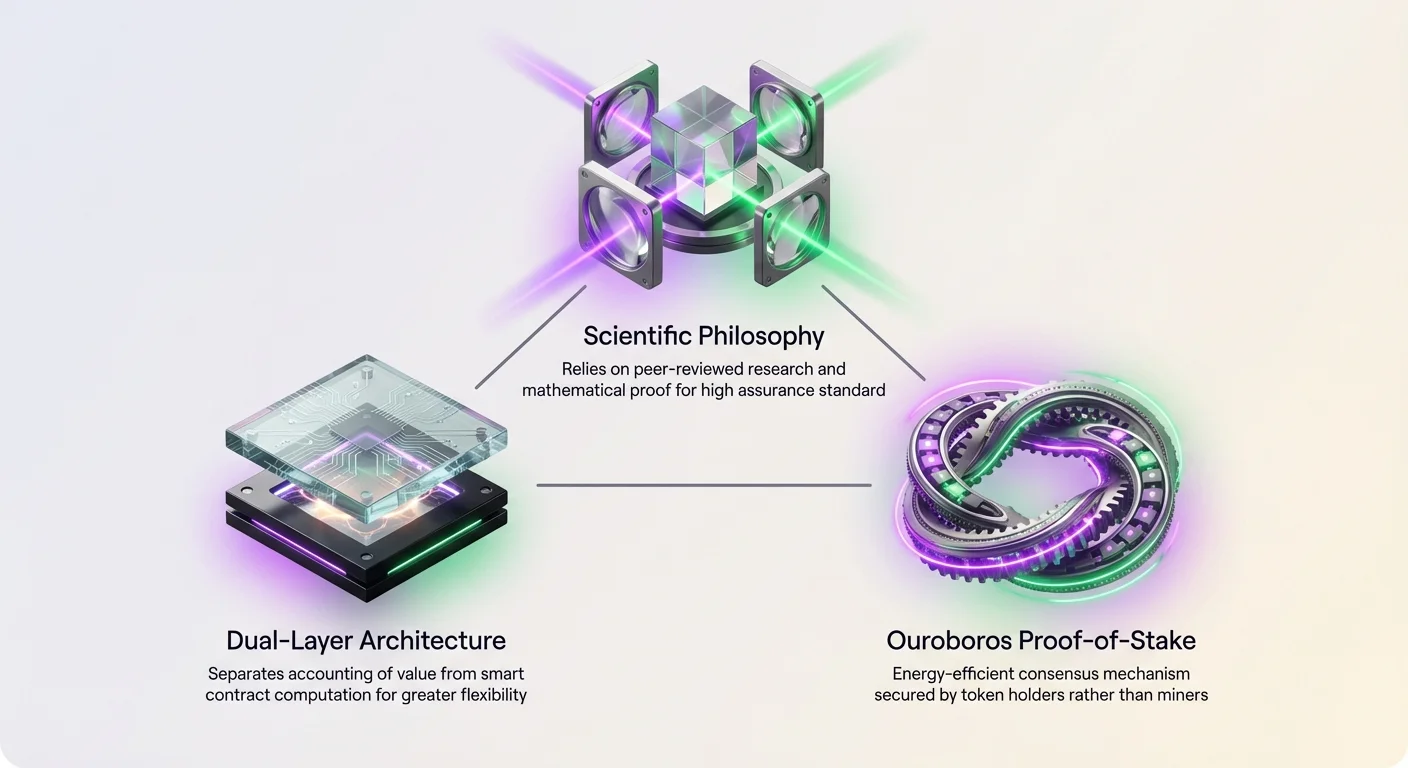
The project differentiates itself by adhering to a scientific philosophy. Unlike the "move fast and break things" ethos common in software startups, Cardano relies on peer-reviewed research. Every protocol upgrade and design decision undergoes rigorous academic scrutiny before implementation. This approach is intended to create a high-assurance system capable of securing billions of dollars in global value.
This commitment to formal verification and academic rigor has garnered a dedicated following. Proponents argue that this slow-and-steady strategy reduces the risk of catastrophic bugs and hacks. By building on a foundation of mathematical proof rather than experimental code, the network aims to provide a more stable infrastructure for the future of decentralized finance.
The Architecture of Assurance
The structural design of this blockchain sets it apart from its contemporaries. Most first and second-generation blockchains, such as Bitcoin and Ethereum, process all activities on a single layer. This means that simple value transfers compete for bandwidth with complex smart contract executions. This congestion often leads to high fees and slower processing times during periods of heavy network usage.
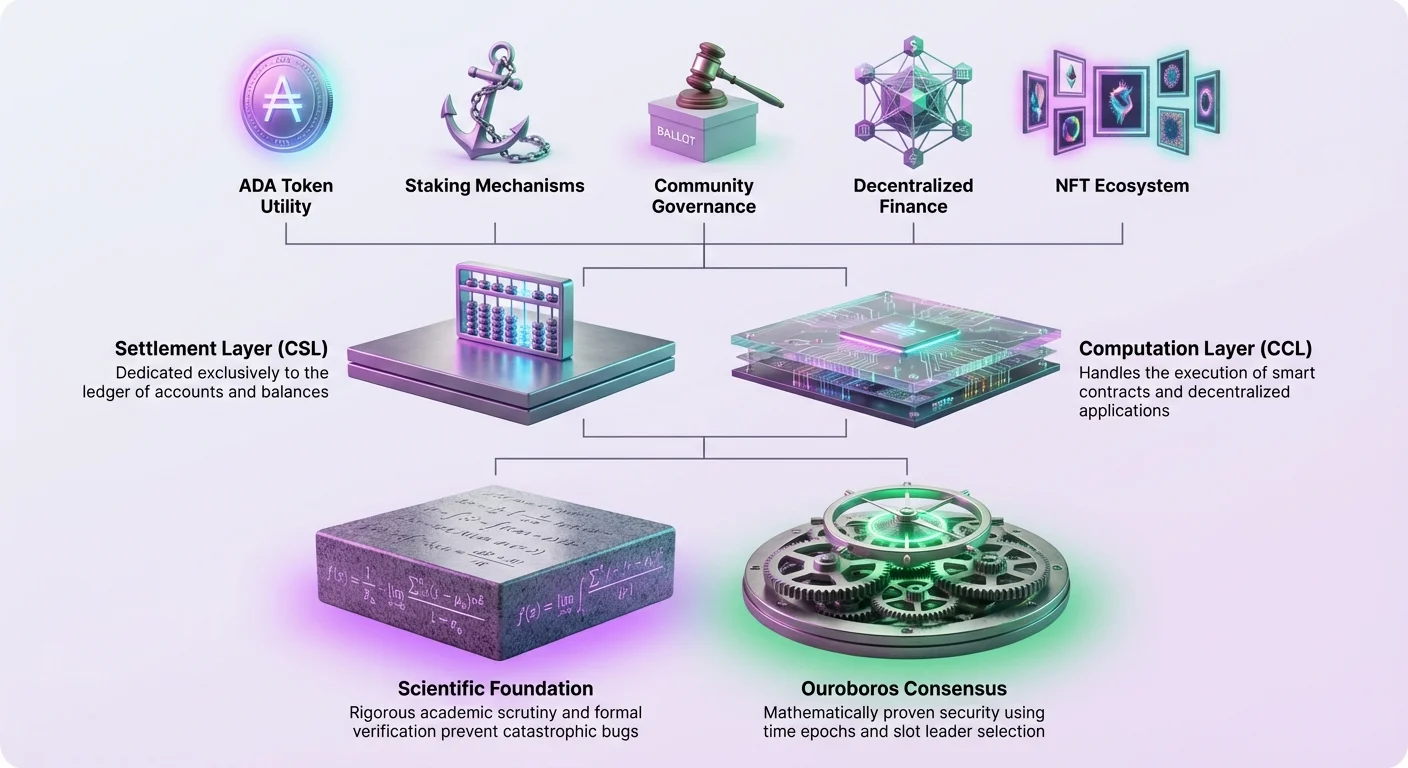
Cardano solves this by splitting its architecture into two distinct layers. The first is the Cardano Settlement Layer (CSL). This layer is dedicated exclusively to the ledger of accounts and balances. It handles the movement of the native currency, ADA, between wallets. By isolating the accounting function, the network ensures that simple transactions remain cheap and efficient.
The second component is the Cardano Computation Layer (CCL). This layer handles the execution of smart contracts and decentralized applications. Separating computation from settlement allows for greater flexibility. Developers can update or change the rules for smart contracts without risking the security of the underlying ledger. This dual-layer approach enhances the system's overall adaptability and security profile.
Ouroboros and Proof-of-Stake
At the heart of the network lies Ouroboros, a custom-designed consensus mechanism. This protocol was the first Proof-of-Stake algorithm to be mathematically proven secure. In a Proof-of-Stake system, the network is secured by token holders rather than miners. This marks a significant departure from the energy-intensive Proof-of-Work model used by Bitcoin.
In the Ouroboros system, time is divided into epochs and slots. For each slot, the network selects a validator to create a block. This selection process is based on the amount of stake a validator controls. The more ADA staked, the higher the probability of being chosen to secure the network. This design ensures that those with the most to lose are responsible for maintaining the integrity of the ledger.
The environmental impact of this shift is profound. Proof-of-Work blockchains consume vast amounts of electricity to power mining rigs. Ouroboros allows Cardano to operate with a fraction of that energy footprint. The entire network can effectively run on the energy equivalent of a single large household or small neighborhood. This sustainability makes it an attractive option for environmentally conscious investors and enterprises.
The Role of the ADA Token
The native cryptocurrency of the network, ADA, serves multiple vital functions within the ecosystem. Named after Ada Lovelace, the 19th-century mathematician often regarded as the first computer programmer, the token is more than just a medium of exchange. It is the fuel that powers the entire decentralized economy of the platform.
Primary uses of the token include:
| Function | Description | Network Impact |
|---|---|---|
| Transaction Fees | Pays for processing transfers and contracts | Prevents network spam |
| Staking | Locks assets to secure the network | Incentivizes honest behavior |
| Governance | Represents voting power | Enables decentralized control |
First and foremost, the token is used to pay for transaction fees. Every transfer of value or execution of a smart contract requires a small payment. This fee serves a dual purpose. It compensates the validators who process the transactions and acts as a deterrent against spam attacks. If transactions were free, a malicious actor could flood the network with useless data.
Beyond fees, the asset functions as a mechanism for network security through staking. Holders can delegate their tokens to stake pools. These pools combine the voting power of many users to increase their chances of validating blocks and earning rewards. This system allows users to participate in consensus and earn a yield on their holdings without needing technical hardware.
Governance and Community Control
A critical component of the roadmap is the transition toward complete decentralization. Many blockchain projects claim to be decentralized but remain heavily influenced by a founding company or small team of developers. Cardano aims to solve this through a robust on-chain governance system that places control directly in the hands of the community.
The governance model allows any ADA holder to participate in the decision-making process. Users can submit proposals for protocol upgrades, funding requests, or changes to network parameters. These proposals are then voted on by the community. The weight of a vote is proportional to the amount of stake a user holds. This ensures that stakeholders with a long-term interest in the project have a say in its direction.
This democratic approach extends to the management of the treasury. A portion of all transaction fees is collected into a centralized pot. The community votes on how to allocate these funds. They can be used to pay developers, fund marketing initiatives, or support educational programs. This self-sustaining funding model ensures the network can continue to evolve without relying on external venture capital.
Decentralized Finance and Smart Contracts
The activation of smart contract functionality marked a major milestone for the platform. This upgrade transformed the network from a simple transactional ledger into a programmable platform capable of hosting complex applications. The ecosystem has since grown to include a variety of decentralized finance (DeFi) protocols.
Decentralized Exchanges (DEXs) are a cornerstone of this ecosystem. These platforms allow users to trade cryptocurrencies directly with one another without an intermediary. By leveraging the security of the underlying blockchain, DEXs eliminate the need to trust a centralized exchange with custody of funds. This aligns with the broader industry trend toward non-custodial financial services.
Lending and borrowing protocols have also emerged. These applications allow users to lend their assets to earn interest or borrow against their holdings. This creates a capital-efficient market where assets can be put to work rather than sitting idle in a wallet. The scientific foundation of the smart contract language is intended to make these financial protocols more secure against hacks and exploits.
The NFT Landscape
Beyond finance, the platform has become a hub for Non-Fungible Tokens (NFTs). The low transaction fees and distinct metadata standards have made it an attractive home for digital artists and creators. Unlike some other chains where minting an NFT can cost significantly more in gas fees, this network offers a cost-effective alternative.
The community around these digital collectibles is vibrant. Projects range from digital art and profile pictures to utility-focused tokens that grant access to exclusive communities or events. The network supports the creation and trading of these unique assets directly on the main ledger. This native support simplifies the process for developers and users alike.
NFTs on this blockchain also benefit from the extended unspent transaction output (eUTXO) model. This technical design allows for more complex logic to be embedded directly into the transaction. For example, royalty payments can be enforced automatically, ensuring creators are compensated every time their work changes hands. This feature has attracted a wave of creative talent to the ecosystem.
Interoperability and Connectivity
No blockchain exists in a vacuum. The developers recognize that the future of crypto is multi-chain. Interoperability, the ability for different blockchain networks to communicate and share data, is a key focus of the long-term roadmap. The goal is to create a seamless web of interconnected ledgers.
Bridges play a crucial role in this vision. These protocols allow assets to move between chains, such as transferring value from Ethereum to Cardano and back. This mobility is essential for liquidity. It prevents ecosystems from becoming isolated silos and allows users to access the best features of each network without being locked into one.
The platform is also exploring sidechains. These are separate blockchains that run parallel to the main network. They can be customized for specific use cases, such as privacy, gaming, or enterprise compliance. By offloading specific tasks to sidechains, the main network remains uncongested while still offering the security of the primary consensus protocol to these auxiliary chains.
Comparative Analysis: Ethereum vs. Cardano
Comparing these two giants reveals distinct approaches to solving the same problems. Ethereum, as the first smart contract platform, benefits from a massive network effect. It has the largest developer community, the most decentralized applications, and the highest total value locked in DeFi. Its development has been rapid, often prioritizing innovation and immediate utility.
Cardano, conversely, prioritizes correctness and long-term sustainability. Its development cycle is slower due to the requirement for peer review. While Ethereum is currently transitioning and upgrading its legacy infrastructure to become more efficient, Cardano built its Proof-of-Stake mechanism from the ground up. This "measure twice, cut once" approach aims to avoid the technical debt that can plague fast-moving software projects.
Another key difference is the accounting model. Ethereum uses an account-based model similar to a bank balance. Cardano uses the eUTXO model, which is more similar to Bitcoin’s method of tracking unspent change. This model offers advantages in terms of determinism and parallel processing. It allows users to predict the exact cost and outcome of a transaction before sending it, reducing failed transactions and wasted fees.
The Road Ahead
The roadmap is divided into distinct eras, each focusing on a specific aspect of development. While the foundation and decentralization phases are largely complete, the focus is shifting toward scaling and governance. The aim is to increase the network's throughput to handle millions of users without compromising speed or security.
Scaling solutions are currently in development. These upgrades intend to increase the block size and optimize the propagation of data across the nodes. By improving the efficiency of the underlying protocol, the network hopes to support enterprise-grade applications. This includes potential use cases in supply chain tracking, identity management, and voting systems.
The final phases of the roadmap focus on self-sustainability. The goal is for the network to become fully autonomous, run and managed by its community without reliance on the founding entities. This represents the ultimate realization of the decentralized dream: a global financial operating system owned by no one and open to everyone.
Conclusion
Cardano stands as a testament to the value of academic rigor in the volatile world of cryptocurrency. Its layered architecture and Ouroboros consensus mechanism offer a compelling alternative to energy-intensive or less secure legacy systems. By prioritizing scientific research and formal verification, it seeks to build a foundation that can endure for decades. The network's evolution from a simple ledger to a complex platform for decentralized finance and governance highlights its ambitious scope.
The journey is far from over. As the platform continues to roll out upgrades and expand its ecosystem, it faces the challenge of attracting users and developers in a competitive market. However, its dedicated community and well-funded treasury provide a strong buffer against market downturns. The shift toward full community governance will be the ultimate test of its design. If successful, it could set a new standard for how decentralized networks are built and managed.
True innovation requires patience, as building a secure financial future is a marathon, not a sprint.