
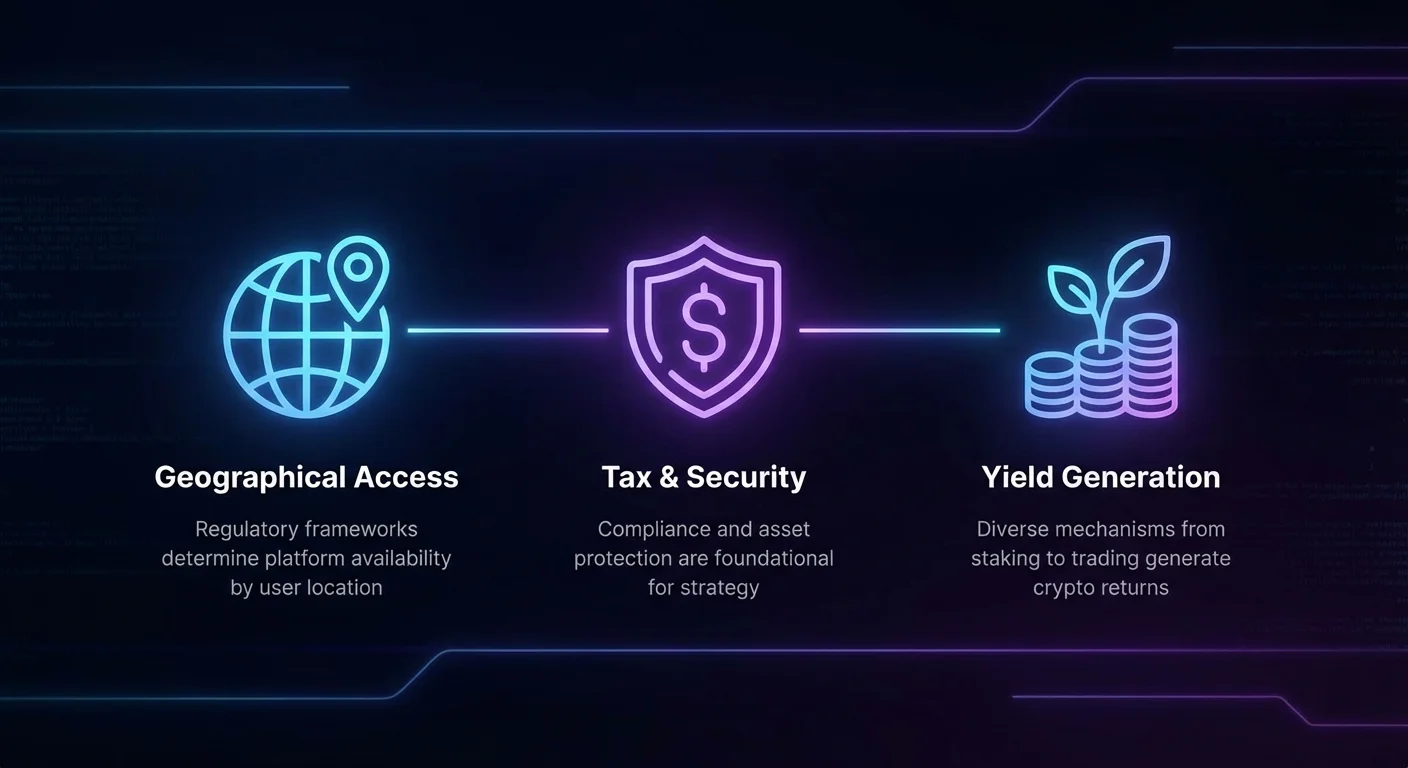
The landscape of digital asset management has evolved significantly beyond simple buy-and-hold strategies. Investors now have access to a diverse array of mechanisms designed to generate yield on their cryptocurrency holdings. These strategies range from passive income models like staking and savings accounts to active trading methodologies such as grid trading and arbitrage. However, the efficiency of these yield generation methods is heavily influenced by two critical factors: the geographical location of the investor and the tax implications of their chosen strategy.
Regulatory frameworks vary drastically across different jurisdictions. This disparity affects which platforms are accessible to specific users and what financial products are legally available. For instance, certain high-yield derivative products or tokenized stock offerings may be restricted in the United States while being widely available in Asian or European markets. Understanding these geographical nuances is the first step in constructing a viable investment strategy.
Tax efficiency is the second pillar of successful yield generation. Different activities trigger different types of tax events. While selling an asset typically incurs capital gains tax, earning interest through lending or staking might be classified as ordinary income. Furthermore, strategies that involve high-frequency transactions, such as automated grid trading, can create complex reporting requirements. This guide explores the intersection of platform features, geographical availability, and yield mechanics to help investors navigate this complex terrain, especially concerning income classification.
Geographical Accessibility and Regulatory Compliance
The availability of crypto trading and investment platforms is not uniform globally. Regulation acts as a gatekeeper, determining which services an investor can access based on their residency. This creates a fragmented market where the "best" platform is often subjective to where a user lives. For investors seeking tax-efficient yield, understanding these jurisdictional boundaries is essential.
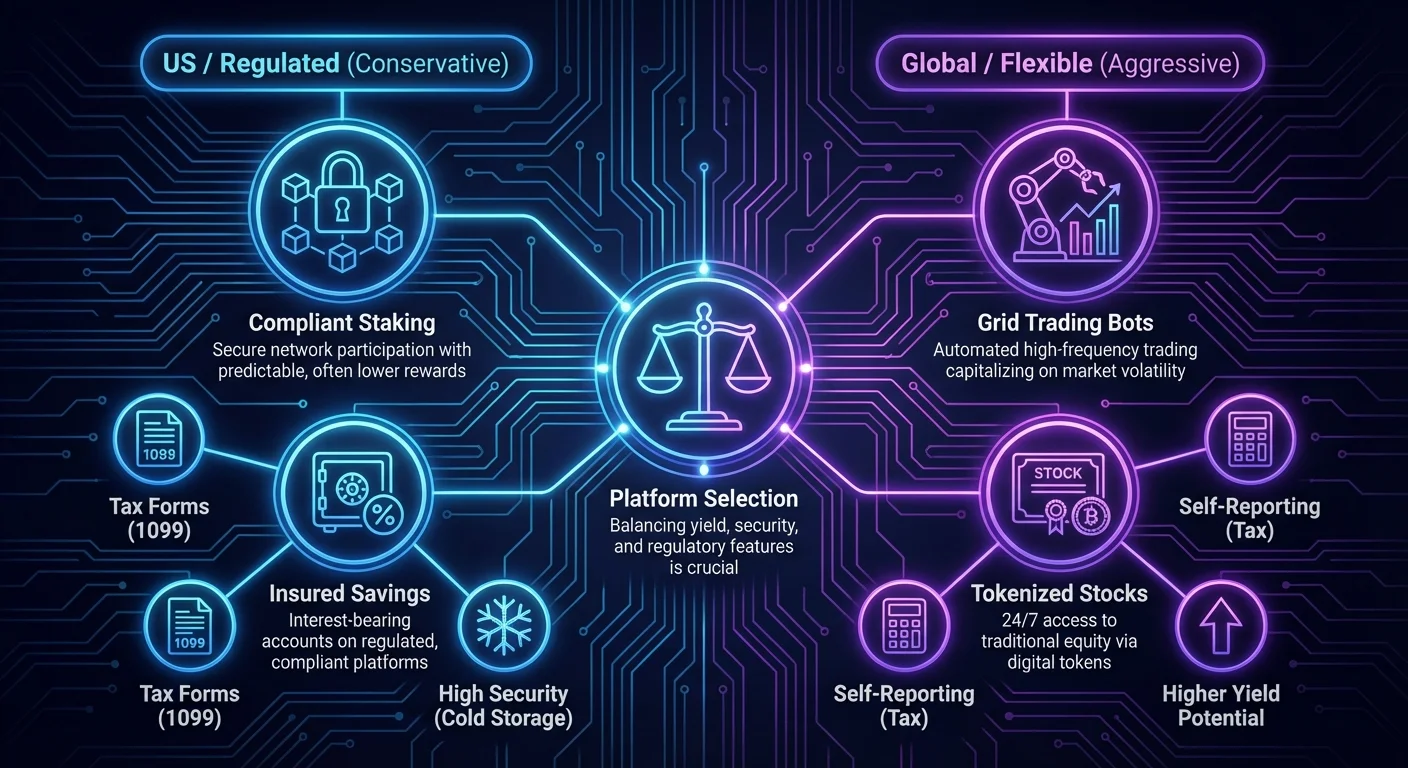
Platforms operating in strict regulatory environments, such as the United States, often have limited feature sets compared to their global counterparts. For example, complex derivative trading, high-leverage futures, and certain lending products may be unavailable to US customers due to guidelines set by the Securities and Exchange Commission (SEC) or the Commodity Futures Trading Commission (CFTC). In contrast, global platforms may offer a broader suite of tools but lack the regulatory oversight that some conservative investors prefer.
The United States Regulatory Environment
In the United States, cryptocurrency exchanges must adhere to rigorous standards. Platforms like Coinbase and Gemini have established themselves by prioritizing compliance with federal and state regulations. For instance, operating in New York requires a "BitLicense," a specific regulatory approval that many global exchanges do not possess. This focus on compliance ensures a high level of security and consumer protection but often comes at the cost of product variety.
US-based investors typically have access to spot trading and basic staking services. However, they are often restricted from participating in margin trading or accessing tokenized stocks on centralized exchanges. This limitation forces US investors to focus on yield generation strategies that fit within these regulatory confines, such as holding assets in interest-bearing accounts or utilizing compliant staking services.
Global and Offshore Opportunities
Outside the United States, the crypto landscape is often more flexible. Platforms serving Asian and European markets, such as Bitget or BTCC, frequently offer a wider array of financial products. These include high-leverage futures, copy trading, and diverse savings products. For international investors, this opens up additional avenues for yield generation that are not available to their American counterparts.
However, this increased access comes with the responsibility of self-regulation regarding tax reporting. While US platforms often provide structured tax documents like 1099 forms, global platforms may not automatically generate reports tailored to a specific country's tax code. Investors using offshore platforms to access higher yields must be diligent in tracking their transactions to ensure they remain compliant with their local tax laws.
The Mechanics of Crypto Lending
Crypto lending has emerged as a primary method for generating passive yield. This mechanism allows holders of digital assets to lend their cryptocurrency to borrowers in exchange for interest payments. The platforms facilitating these transactions act as intermediaries, managing the collateral and interest rates. This model is similar to a traditional savings account but typically offers significantly higher interest rates due to the volatility and demand within the crypto market.
From a tax perspective, lending can be distinct from trading. When an investor lends their crypto, they are generally not selling the asset, which means capital gains tax is not triggered upon the deposit. Instead, the interest earned is typically treated as ordinary income. This distinction is vital for long-term holders who wish to generate liquidity or yield without divesting from their positions and triggering a taxable sale.
Understanding Loan-to-Value (LTV) Ratios
A critical concept in crypto lending is the Loan-to-Value (LTV) ratio. This metric determines how much an investor can borrow relative to the value of their collateral. For example, a platform might offer a 50% LTV, meaning if a user deposits $10,000 worth of Bitcoin, they can borrow $5,000 in stablecoins or fiat currency.
Managing LTV is crucial for protecting capital. If the value of the collateral drops significantly due to market volatility, the LTV ratio increases. If it breaches a specific threshold, the platform may issue a margin call or liquidate the collateral to cover the loan. Liquidation is a taxable event, as the platform essentially sells the user's crypto. Therefore, maintaining a conservative LTV is a key strategy for tax-efficient lending.
Collateralization and Asset Security
The security of the lending model relies heavily on collateralization. Unlike traditional personal loans which rely on credit scores, crypto loans are secured by digital assets. This allows for instant approval without credit checks, democratizing access to liquidity. Platforms typically require over-collateralization, meaning the value of the pledged assets must exceed the value of the loan.
For yield generators, this system provides a layer of security. Lenders know that their deposits are backed by borrower collateral. However, the safety of the yield also depends on the platform's internal risk management protocols. High-quality platforms employ robust liquidation engines and insurance funds to ensure lenders are made whole even during extreme market downturns.
Staking and Savings Accounts
Staking and crypto savings accounts represent another pillar of yield generation. Staking involves locking up proof-of-stake (PoS) cryptocurrencies to support the operations of a blockchain network. In return for securing the network, participants receive rewards. Savings accounts on centralized exchanges operate similarly but may involve the platform lending the assets out rather than staking them directly on-chain.
The tax treatment of staking rewards is a subject of ongoing discussion in many jurisdictions, but it is commonly treated as income at the time of receipt based on the fair market value of the coin. This differs from capital gains, which only applies when an asset increases in value and is sold. Investors must meticulously record the value of rewards when they are received to calculate their tax liability accurately.
Flexible Savings Options
Flexible savings accounts offer investors the ability to earn interest while retaining immediate access to their funds. Users can deposit and withdraw their assets at any time, making this an ideal solution for those who need liquidity. Platforms like Binance and Bitget offer flexible savings products for a wide variety of cryptocurrencies.
The trade-off for this liquidity is typically a lower interest rate compared to fixed-term options. However, for active traders or those who may need to sell assets quickly in response to market movements, flexible accounts provide a balance between earning yield and maintaining operational agility.
Fixed-Term Commitments
Fixed-term savings accounts require users to lock their assets for a predetermined period, such as 30, 60, or 90 days. In exchange for this commitment, platforms offer higher Annual Percentage Yields (APY). This strategy is best suited for long-term holders who do not intend to sell their assets in the near future.
While the yield is higher, the lack of liquidity poses a risk. If the market crashes during the lock-up period, the investor cannot sell their position to mitigate losses. Additionally, early withdrawal often comes with penalties that can negate accrued interest. Investors must weigh the higher yield against the opportunity cost of having their capital illiquid.
Automated Trading Strategies
Automation has revolutionized how retail investors approach the crypto market. Trading bots and algorithmic strategies allow users to execute trades 24/7 without constant monitoring. One of the most popular automated strategies is grid trading. This method involves placing a series of buy and sell orders at predefined price intervals. As the price fluctuates, the bot executes trades to capture small profits from the volatility.
While grid trading can be highly effective in sideways markets, it presents significant tax challenges. A single grid trading bot can execute hundreds or even thousands of trades in a relatively short period. In most jurisdictions, every single trade is a taxable event that must be reported. This high volume of transactions can complicate tax filing and increase the administrative burden on the investor.
How Grid Trading Works
Grid trading capitalizes on normal market volatility. A user sets a price range (e.g., Bitcoin between $60,000 and $65,000) and the number of "grids" or levels within that range. The bot places buy orders at lower levels and sell orders at higher levels. When the price drops, it buys; when the price rises, it sells the accumulated position for a profit.
This strategy is particularly useful for assets that are consolidating or trading within a predictable range. It removes the emotional component of trading, ensuring that the strategy is executed consistently. However, if the price breaks out of the defined range, the bot may stop trading or leave the investor holding a position at a loss, requiring manual intervention.
Managing Transaction Volume
The sheer volume of transactions generated by automated bots necessitates robust record-keeping tools. Investors utilizing grid trading strategies should use specialized crypto tax software that can import transaction history directly from exchanges via API. Manually calculating the cost basis and capital gain for thousands of micro-transactions is practically impossible.
Furthermore, the cost of trading fees can accumulate quickly with high-frequency strategies. Investors must choose platforms with low trading fees or robust VIP programs to ensure that fees do not eat into the profits generated by the grid bot. Platforms like PrimeXBT and KuCoin are often favored for these strategies due to their competitive fee structures and advanced API capabilities.
Day Trading and Market Volatility
Day trading involves buying and selling cryptocurrencies within the same trading day to profit from short-term price movements. This active yield generation strategy requires a deep understanding of market mechanics, technical analysis, and risk management. Unlike passive strategies, day trading demands constant attention and quick decision-making.
The tax implications of day trading are straightforward but can be burdensome. Profits from assets held for less than a year are typically taxed as short-term capital gains, which often have higher rates than long-term capital gains. Successful day traders must factor these higher tax rates into their profitability calculations.
Volatility and Opportunity
Cryptocurrency markets are known for their extreme volatility. Prices can swing by double-digit percentages in a single day. For day traders, this volatility is the source of yield. Platforms that offer high liquidity and fast execution speeds are essential for capturing these fleeting opportunities.
Top exchanges for day trading, such as Binance and Coinbase, provide advanced charting tools and real-time data feeds. These features allow traders to analyze market trends and execute orders with precision. However, volatility is a double-edged sword; while it offers profit potential, it also increases the risk of significant losses.
The Cost of Frequent Trading
Frequent trading incurs costs beyond taxes. Trading fees, including maker and taker fees, are charged on every transaction. Spread costs, which are the difference between the buy and sell price, also impact profitability. Over thousands of trades, these small costs compound.
To mitigate this, day traders often seek out platforms with tiered fee structures or zero-fee promotions. Some exchanges offer reduced fees for users who hold their native token or achieve high monthly trading volumes. Minimizing these operational costs is critical for maintaining a positive net yield in an active trading strategy.
Zero-Fee Trading Models
In an effort to attract users, some exchanges have introduced zero-fee trading on specific pairs or for certain order types. This model eliminates commission fees, allowing traders to keep 100% of their gross profits. This is particularly advantageous for high-frequency traders and those utilizing automated bots, where fees can significantly erode margins.
However, investors should scrutinize zero-fee models carefully. Some platforms may compensate for the lack of commissions by widening the spread, meaning users pay a higher price to buy and receive a lower price to sell. True cost efficiency requires analyzing both the commission schedule and the average spread on the platform.
| Fee Model | Description | Best For |
|---|---|---|
| Flat Fee | Fixed percentage per trade | Occasional traders |
| Tiered Fee | Rates drop as volume rises | High-volume traders |
| Zero-Fee | No commission charged | Scalpers / Bots |
Understanding Fee Structures
Fee structures are generally divided into "maker" and "taker" categories. Makers are traders who place limit orders that add liquidity to the order book. Takers are traders who place market orders that remove liquidity. Exchanges often incentivize makers with lower fees (or even rebates) to ensure deep liquidity on their platform.
Zero-fee promotions are often temporary or limited to specific trading pairs, such as Bitcoin to stablecoin pairs. Traders should remain aware of when these promotions expire to avoid unexpected costs. Additionally, withdrawal fees should be considered, as high costs to move funds off the platform can negate the benefits of low trading fees.
Impact on Net Returns
The impact of fees on long-term yield cannot be overstated. For a trader executing significant volume, a difference of 0.1% in fees can amount to thousands of dollars annually. By selecting platforms that align with their trading frequency and volume, investors can optimize their net returns.
It is also worth noting that fees are generally tax-deductible expenses that reduce the cost basis of a trade. This means that while fees reduce immediate profit, they also slightly lower the capital gains tax liability. Accurate tracking of these fees is essential for precise tax reporting.
Tokenized Stocks and Hybrid Assets
Tokenized stocks represent a convergence of traditional finance and the cryptocurrency ecosystem. These are digital tokens that track the price of publicly traded equity shares, such as Apple or Tesla. By trading tokenized stocks on crypto exchanges, investors can gain exposure to the stock market without needing a traditional brokerage account.
This innovation allows for fractional ownership, meaning investors can buy a fraction of a high-priced share. It also enables 24/7 trading, as crypto markets do not close like traditional stock exchanges. This accessibility is particularly beneficial for global investors who may find it difficult to access US stock markets through traditional means.
Bridging Traditional Finance
Tokenized stocks serve as a bridge for crypto-native investors to diversify their portfolios into traditional assets without leaving the crypto ecosystem. This consolidation simplifies asset management, as users can hold Bitcoin, stablecoins, and stock tokens in a single wallet.
However, the regulatory status of tokenized stocks is complex. In some jurisdictions, they may be classified as securities, subjecting the exchange and the trader to strict compliance rules. Investors should verify that the platform offering these tokens is operating legally within their jurisdiction to avoid potential regulatory crackdowns.
Accessibility and Trading Hours
One of the primary advantages of tokenized stocks is the removal of temporal barriers. Traditional stock markets operate during specific business hours, often limiting the ability of international investors to react to news in real-time. Tokenized assets trade around the clock, providing flexibility and the ability to hedge positions instantly.
This continuous liquidity creates new yield generation opportunities, such as arbitrage between the tokenized asset and the traditional underlying stock. However, it also means that price gaps can occur between the token price and the actual stock price when the traditional market is closed.
Swap Platforms and Instant Exchange
Swap platforms provide a simplified method for exchanging one cryptocurrency for another. Unlike traditional exchanges with complex order books, swap services offer a straightforward interface where users input the amount they wish to exchange and receive a quote. These platforms often aggregate liquidity from multiple sources to provide competitive rates.
From a tax perspective, swapping one crypto for another is a taxable event in most jurisdictions. Even if the investor never converts back to fiat currency, the IRS and other tax bodies view a swap as selling the first asset at its fair market value and using the proceeds to buy the second asset.
Non-Custodial Swapping
Many swap platforms operate on a non-custodial basis. This means the user retains control of their private keys throughout the process. Funds are sent from the user's wallet to the swap service, exchanged, and immediately returned to the user's wallet. This minimizes counterparty risk, as funds are not held on a centralized exchange.
Non-custodial swaps are popular among privacy-conscious investors and those who prioritize security. Platforms like ChangeNOW and CCE Cash facilitate these transactions without requiring extensive registration, although this varies based on the size of the transaction and local regulations.
Speed and Convenience
The primary appeal of swap platforms is speed. Transactions are often completed in minutes, allowing users to rebalance their portfolios quickly. This is particularly useful during periods of high market volatility when delays can result in missed opportunities.
However, this convenience can come with higher fees compared to spot trading on a centralized exchange. The spread on swap platforms is often wider to account for the volatility risk taken by the service provider. Users should compare the quoted rate against the market rate to ensure they are receiving a fair deal.
Security Considerations for Yield Generators
No yield generation strategy is effective if the underlying capital is lost to theft or insolvency. Therefore, evaluating the security measures of a platform is as important as comparing interest rates. Top-tier platforms employ a multi-layered security approach that includes cold storage, multi-signature wallets, and regular security audits.
Cold storage involves keeping the majority of user funds in offline wallets that are not connected to the internet. This makes them immune to online hacking attempts. Platforms like Coinbase and Kraken keep a vast percentage of assets in cold storage, providing a high level of assurance to their users.
Custodial Security Measures
Custodial platforms hold the private keys on behalf of the user. This places the burden of security on the exchange. Reputable exchanges carry insurance policies to cover potential losses resulting from security breaches. For example, Gemini has obtained SOC 1 Type 2 and SOC 2 Type 2 certifications, demonstrating a high standard of operational security.
Investors should look for platforms that are transparent about their reserves. Proof-of-Reserves (PoR) audits have become a standard way for exchanges to prove that they hold 1:1 backing for all user assets. This transparency helps mitigate the risk of insolvency and builds trust within the community.
User-Side Protections
Security is a shared responsibility. While platforms secure the infrastructure, users must secure their accounts. Two-factor authentication (2FA) is a mandatory requirement for any serious investor. Using hardware keys or authenticator apps is significantly safer than SMS-based 2FA, which is vulnerable to SIM-swapping attacks.
Additionally, features like address whitelisting allow users to restrict withdrawals to specific, pre-approved addresses. This ensures that even if an account is compromised, the attacker cannot withdraw funds to their own wallet. Utilizing these tools is essential for safeguarding yield-generating assets.
Strategic Platform Selection
Choosing the right platform involves balancing yield potential, fees, security, and regulatory compliance. A platform that offers the highest APY on staking may not be the best choice if it has a history of security lapses or operates in a regulatory gray area. Investors must conduct due diligence to find the platform that aligns with their risk tolerance and geographical constraints.
For US investors, the choice is often narrowed to fully compliant exchanges like Coinbase, Kraken, or Gemini. While these platforms may offer fewer exotic products, their regulatory standing provides long-term stability. For international investors, platforms like Binance or Bitget offer a wider playground of financial tools, but require greater vigilance regarding self-custody and tax reporting.
Evaluating Customer Support
In the world of finance, the ability to resolve issues quickly is paramount. Reliable customer support is a critical feature for any trading or investment platform. Whether it is a failed deposit, a login issue, or a question about a complex lending product, having access to responsive support can prevent financial loss.
Top platforms offer 24/7 support via live chat or email. Reading user reviews and testing the support channels before committing significant capital can provide insight into the quality of service. A platform with poor support can become a significant liability during times of market stress.
Educational Resources and Interfaces
A user-friendly interface reduces the likelihood of costly errors. Platforms that prioritize design make it easier to execute trades, manage loans, and monitor staking rewards. Additionally, educational resources provided by the exchange help users understand the products they are using.
Many platforms now offer "Learn to Earn" programs, where users are rewarded with small amounts of crypto for completing educational modules. This not only incentivizes learning but also helps users become more proficient investors. Understanding the mechanics of a product is the first step in using it to generate tax-efficient yield.
Conclusion
Tax-efficient yield generation in the cryptocurrency market requires a multifaceted approach. Investors must navigate a complex landscape of varying regulations, tax laws, and platform features. By understanding the distinction between income-generating activities like staking and capital gains events like trading, investors can structure their portfolios to optimize after-tax returns. The geographical location of the investor plays a decisive role in determining which tools and strategies are available, necessitating a tailored approach based on residency.
Security remains the foundation of any investment strategy. The allure of high yields should never overshadow the importance of platform reliability and asset protection. Whether utilizing automated grid trading, participating in lending pools, or simply holding assets in a savings account, the safety of the principal is paramount. By combining robust security practices with a clear understanding of tax obligations and platform capabilities, investors can effectively harness the potential of the digital asset economy.
Successful yield generation relies on balancing regulatory compliance, tax efficiency, and platform security to protect and grow your principal.