
Bitcoin is often viewed as a static digital currency, a digital gold that remains unchanged over time. However, the protocol is software that must be maintained, fixed, and upgraded to survive. Developers work continuously to fix critical bugs and deliver upgrades that ensure the system stands the test of time. While the network is decentralized, meaning no single CEO or board of directors makes decisions, changes still occur.
The process for evolving Bitcoin is distinct from centralized entities where decisions happen in a top-down manner. The term governance is somewhat loosely applied here because it often implies leaders acting as proxies for the masses. In Bitcoin, there are no such leaders. The process is quasi-political in the sense that stakeholders must jockey for influence, but it is not a democracy or a plutocracy.
Instead of voting or electing officials, the network relies on consensus building. Deliberation and persuasion are critical tools in this environment. Ultimately, all participants retain their own volition. It is an opt-in system where everyone has the choice to go their own way. The network is defined by what its users choose to run on their computers.
The default culture among participants is that the protocol does not change unless it absolutely must. Unless a vast majority agrees to a modification, the status quo remains. Those who wish to change the rules are always free to fork the software and create their own version. This dynamic has led to significant historical events where the network split into competing factions.
The Role of Improvement Proposals
The code upgrade implementation process is formalized through Bitcoin Improvement Proposals, known as BIPs. These documents are drafted, peer-reviewed, publicly debated, and rigorously tested. The goal of a BIP is to establish rough consensus among the community. Rough consensus is achieved when most people are satisfied that objections to the proposal are wrong or have been addressed.
Once this consensus is reached, the next step is integrating the BIP into the software client implementation known as Bitcoin Core. A small number of core developers have commit access to the code repository. This means they can upload the code to the public platform recognized by the community. However, their power is limited by the node operators.
The final and most critical step is for the network of users, or nodes, to install the new version of the software. This step ensures that end users retain ultimate control over what defines the network. Only when a defined threshold of nodes installs the upgrade is it considered activated. For changes that materially alter the protocol, the barrier to activation is set extremely high to prevent contention.
Consensus and Node Power
There are wide arrays of voices in this ecosystem. Developers, miners, exchanges, wallet providers, and independent node operators all participate. These groups are locked in a dynamic power struggle where checks and balances prevent any single group from wielding outsized influence.
For instance, there are only about 100 developers listed as contributors to the Bitcoin Core client. One might conclude they control the network. However, there are tens of thousands of independent nodes. Since most nodes independently decide which software client to run, developers are beholden to nodes. If developers release software that is incompatible with the desires of the users, the nodes will simply refuse to adopt it.
Miners are another group often thought to have total control because they order transactions. The argument is that a contingent of miners possessing more than 50% of the hashpower could hijack the network. However, miners are also beholden to nodes. If miners produce blocks that violate the rules nodes agree upon, the nodes will reject those blocks. The miners would then be wasting electricity and money on a version of the chain that the economic majority ignores.
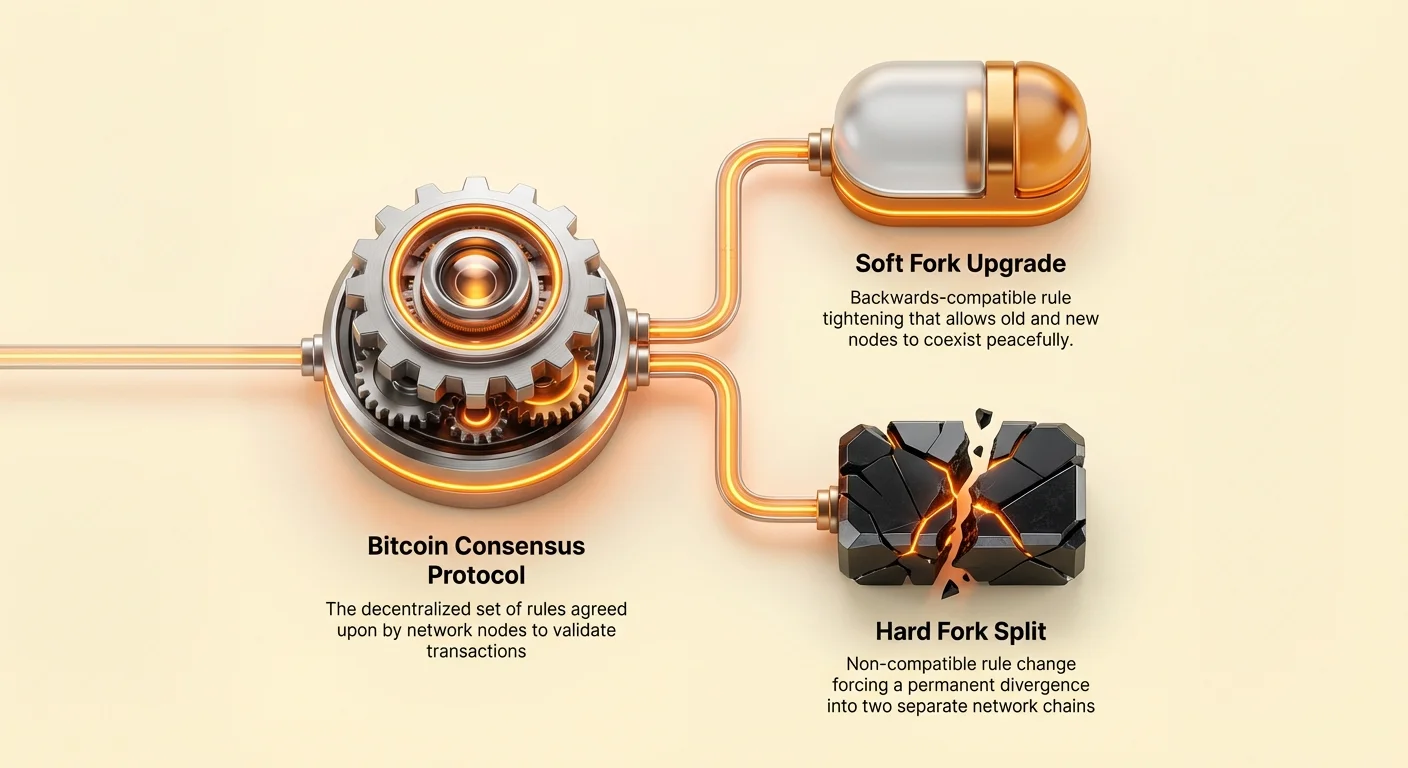
Defining Network Upgrades: Soft vs. Hard Forks
When upgrades are proposed, they generally fall into two categories: soft forks and hard forks. The distinction lies in how the new rules interact with the old rules. This technical difference has profound implications for community cohesion and network continuity.
A soft fork is a backwards-compatible upgrade. This means that nodes running the new version of the software remain compatible with nodes running the previous version. In a soft fork, the new rules are tighter or more restrictive than the old rules. Old nodes will still see the new transactions as valid, even if they do not understand the new features being implemented.
Because of this compatibility, soft forks do not require the entire network to upgrade simultaneously. It provides a smoother transition path. Nodes that do not upgrade can still participate in the network, though they may not be able to use the new features. This mechanism provides nodes, rather than developers, with the final say on implementation.
The Nature of Hard Forks
When a proposal is not backwards compatible, it is known as a hard fork. In this scenario, the new rules effectively contradict the old rules. Only nodes that run the new version are compatible with each other. The entire community of nodes must agree to use the new version to stay on the same network.
If any segment of the community does not agree to install and run the new software, the result is a permanent divergence. The blockchain splits into two separate chains that no longer communicate. One chain follows the old rules, and the other follows the new rules. This creates two distinct cryptocurrencies with a shared history up until the point of the split.
Hard forks usually occur due to significant disagreements regarding the future direction of the protocol. These can stem from debates over scalability, security fixes, or ideological differences about the coin's purpose. When these disagreements cannot be resolved through consensus, a split becomes the only way for both sides to pursue their vision.
| Feature | Soft Fork | Hard Fork |
|---|---|---|
| Compatibility | Backwards compatible | Not compatible |
| Upgrade Need | Optional for some nodes | Mandatory for all |
| Outcome | Single chain persists | Chain splits in two |
The Consequences of Splitting
The implications of a hard fork are significant. First, a new cryptocurrency is created. If a user held coins on the original chain before the fork, they typically receive an equal amount of the new coin on the new chain. This is because both chains share the same history and ledger up to the block where the split occurred.
Price volatility is another major consequence. The market must decide the value of the two competing chains. This can lead to confusion among users and businesses. Replay attacks, where a transaction on one chain is maliciously repeated on the other, can also be a risk if proper protections are not implemented.
Furthermore, hard forks fracture the community. Developers, miners, and users must choose sides. This division can dilute the network effect, which is one of the primary value drivers of a cryptocurrency. While some see forks as a feature that allows for market choice, others view them as a threat to stability and security.
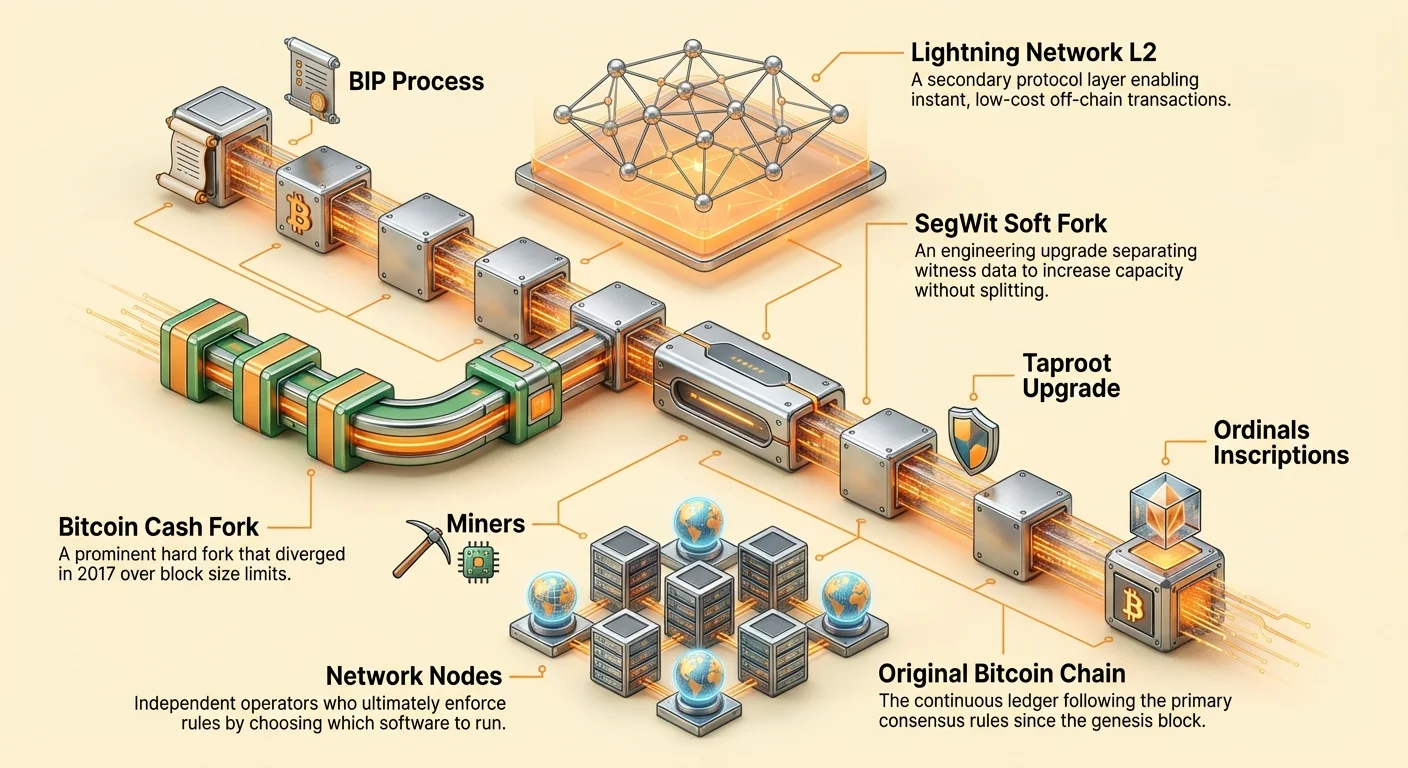
The Block Size Wars and Bitcoin Cash
The most consequential hard fork in history occurred in 2017. It was the culmination of a years-long debate known as the "Block Size War." The disagreement centered on how to scale the network to handle more transactions.
As adoption grew, the original design, which supports limited transactions per second, began to struggle. Blocks were becoming full, leading to network congestion. This resulted in slower transaction times and higher fees. During peak periods, using the network for small payments became impractical.
One camp believed the solution was to increase the block size limit. They argued that larger blocks would allow more transactions to be processed at once, keeping fees low and maintaining the utility of the currency for everyday payments. They viewed the asset primarily as a medium of exchange, similar to digital cash.
The opposing camp argued that increasing the block size would make the blockchain too large for average users to store. They believed this would lead to centralization, where only large data centers could run nodes. They advocated for keeping blocks small to preserve decentralization and using other layers for scaling.
The Birth of Bitcoin Cash
In August 2017, the disagreement reached a breaking point. Participants were unable to agree on a unified method for scaling. A group of developers and miners initiated a hard fork to increase the block size limit. This resulted in the creation of Bitcoin Cash (BCH).
Bitcoin Cash increased the block size to allow for greater transaction throughput. It aimed to fulfill the vision of a peer-to-peer electronic cash system with low fees. The split was contentious, with both sides claiming to represent the "true" vision of the original white paper.
Since the fork, Bitcoin and Bitcoin Cash have operated as completely separate networks. They have different development teams, different market values, and different roadmaps. While they share the same genesis block and early history, they are now distinct assets with different philosophies regarding scaling and utility.
Subsequent Forks and Fragmentation
Following the Bitcoin Cash split, other hard forks occurred. In October 2017, Bitcoin Gold (BTG) was launched. Its goal was to decentralize mining by changing the proof-of-work algorithm. The creators wanted to make mining accessible to users with standard graphics cards rather than expensive specialized equipment.
Another notable split happened within the Bitcoin Cash network itself. In November 2018, a disagreement over block size limits and technical features led to the creation of Bitcoin SV (BSV). Proponents of BSV advocated for massive block sizes to scale capacity to enterprise levels.
Bitcoin Diamond (BCD) also emerged in late 2017. It increased the block size limit and adjusted the total supply of coins. Each of these forks attempted to address perceived shortcomings of the main protocol. However, the success of a fork depends heavily on community support and developer competence. Most forks have not maintained the same relevance or market capitalization as the original chain.
Segregated Witness: The Soft Fork Alternative
While the big block camp opted for a hard fork, the main network pursued a soft fork upgrade called Segregated Witness, or SegWit. Introduced in 2017, SegWit was a clever engineering solution to the scaling problem that did not require a chain split.
SegWit works by changing how transaction data is stored. In a standard transaction, the digital signature, or "witness data," takes up a significant amount of space. SegWit separates this witness data from the main transaction block. It moves the signatures to an extended block structure.
By doing this, SegWit effectively increased the block size limit without technically changing the 1MB rule that older nodes enforced. It introduced the concept of "weight units." Witness data is counted with less weight than other transaction data. This allows more transactions to fit into a single block, increasing throughput and lowering fees.
Fixing Transaction Malleability
Beyond scaling, SegWit fixed a critical bug known as transaction malleability. Before SegWit, it was possible to slightly alter the unique ID of a transaction before it was confirmed. This did not change the validity of the payment but created problems for second-layer protocols.
By separating the signature from the transaction ID, SegWit ensured that transaction IDs could not be modified. This fix was essential for the development of the Lightning Network. It provided the security foundation needed for off-chain payment channels to function reliably.
The User Activated Soft Fork (UASF)
The activation of SegWit was a pivotal moment in governance history. It involved a strategy called the User Activated Soft Fork, or UASF. Traditionally, upgrades were signaled by miners. However, miners were hesitant to activate SegWit.
In response, a grassroots movement of users decided to run a version of the software (BIP 148) that would reject blocks from miners who did not support SegWit. This put economic pressure on miners. If they did not upgrade, their blocks would be rejected by the user nodes, and they would lose revenue.
The strategy worked. It demonstrated that the collective will of the user base could force the hand of miners. It reinforced the decentralized ethos that users, not miners or developers, are the ultimate authority in the network.
Taproot: Expanding Privacy and Smart Contracts
In November 2021, the network activated another major soft fork known as Taproot. Like SegWit, this was a backwards-compatible upgrade. It introduced Schnorr signatures and Merkelized Abstract Syntax Trees (MAST).
Schnorr signatures replaced the existing signature scheme with a more efficient one. They allow for signature aggregation. This means multiple signatures can be combined into a single one. For complex transactions involving multiple parties, this reduces the amount of data that needs to be stored on the blockchain.
MAST improves privacy and efficiency for smart contracts. It allows complex conditions to be structured in a way where only the relevant parts are revealed when the coins are spent. To an outside observer, a complex smart contract transaction looks the same as a standard payment.
Implications for Functionality
Taproot paved the way for more advanced scripting capabilities. It made complex transactions cheaper because they take up less space. It also enhanced privacy by making different types of transactions indistinguishable from one another.
This upgrade demonstrated that the network could still innovate and add features without causing a contentious hard fork. It showed that the governance process, while slow and deliberate, could successfully deliver material improvements to the protocol.
Scaling Without Forks: Layer 2 Solutions
As the limitations of on-chain scaling became clear, development shifted toward Layer 2 solutions. These are secondary protocols built on top of the main blockchain. They handle transactions off-chain and use the main chain only for final settlement.
The most prominent example is the Lightning Network. It uses state channels to allow two parties to transact unlimited times without recording every transfer on the blockchain. Only the opening and closing balances are recorded. This allows for near-instant, low-cost payments.
Layer 2s offer scalability without compromising the security or decentralization of the base layer. They avoid the need for controversial hard forks to increase block size. By moving small, frequent transactions off-chain, the main network remains uncongested and secure.
Sidechains
Sidechains are another mechanism for extending functionality. A sidechain is an independent blockchain that is pegged to the main Bitcoin chain. Assets can be moved between the two chains using a two-way peg.
Sidechains can have their own consensus rules. They can support faster block times or different features that are not possible on the main chain. For example, the Liquid Network focuses on fast, confidential transactions for exchanges. Rootstock brings Ethereum-style smart contracts to the Bitcoin ecosystem.
Because sidechains are separate, issues on a sidechain do not directly threaten the security of the main network. This allows for experimentation and innovation. If a feature on a sidechain proves valuable and safe, it might eventually be considered for the main protocol.
Modern Innovations and Controversies
The evolution of the network continues with new concepts that push the boundaries of what is possible. The introduction of SegWit and Taproot inadvertently enabled new types of data storage. This led to the rise of Ordinals.
Ordinals are a system for numbering individual satoshis, the smallest unit of the currency. By assigning a unique number to a satoshi, users can track it. More importantly, they can inscribe data onto it. This data can be images, text, or even simple games.
This created a way to mint non-fungible tokens (NFTs) directly on the blockchain. The data is stored in the witness portion of the transaction, which is cheaper thanks to SegWit. While some users celebrate this as a new use case that increases miner revenue, others view it as spam that congests the network.
OP_CAT and Scripting
Another area of active research is the restoration of old opcodes. OP_CAT is a piece of code that was removed in the early days of the project due to security concerns. It allows for the concatenation, or joining, of two pieces of data in a script.
Proponents argue that bringing back OP_CAT would enable more powerful smart contracts without requiring a complex overhaul of the system. It could facilitate decentralized exchanges and more advanced covenants directly on the base layer. This represents the ongoing debate between adding functionality and minimizing risk. The evolution of the network continues with new concepts that push the boundaries of what is possible. The introduction of SegWit and Taproot inadvertently enabled new types of data storage. This led to the rise of Ordinals. Another area of active research is the restoration of old opcodes. OP_CAT is a piece of code that was removed in the early days of the project due to security concerns. It allows for the concatenation, or joining, of two pieces of data in a script.
Interoperability and Wrapped Assets
While internal upgrades continue, the broader crypto ecosystem has developed ways to use Bitcoin on other chains. Wrapped Bitcoin (WBTC) and Threshold Bitcoin (tBTC) are examples of tokenized versions of the asset that exist on blockchains like Ethereum.
WBTC relies on a custodian to hold the real coins and issue the tokens. This brings liquidity to decentralized finance (DeFi) applications on other networks. tBTC attempts to do this in a more decentralized way using threshold cryptography to avoid a single point of failure.
These solutions allow holders to participate in lending, borrowing, and trading on platforms that support complex smart contracts. They bridge the gap between the secure store of value and the flexible world of DeFi.
Conclusion
The history of Bitcoin is defined by its struggle to balance stability with innovation. Through the mechanisms of soft forks and hard forks, the network has navigated profound disagreements and technical challenges. The split with Bitcoin Cash highlighted the difficulty of reaching consensus on scaling, while upgrades like SegWit and Taproot demonstrated the power of backwards-compatible improvements.
Today, the ecosystem continues to evolve through Layer 2 solutions, sidechains, and new protocols like Ordinals. The governance process remains slow and deliberate by design, prioritizing the security and integrity of the decentralized ledger above all else. As new technologies like fractal scaling and restored opcodes are proposed, the community will once again engage in the rigorous debate that defines this digital economy.
Bitcoin evolves through a rigorous consensus process where users ultimately decide the rules by choosing which software to run.