
Understanding the dynamics of capital flow within the cryptocurrency market is essential for any investor analyzing market trends. The movement of liquidity between different asset types creates distinct cycles that define market sentiment and price action. Unlike traditional equity markets where sectors may move independently, the crypto market often moves in a synchronized yet staggered manner. This phenomenon is primarily observed through the relationship between Bitcoin and alternative cryptocurrencies, often referred to as altcoins.
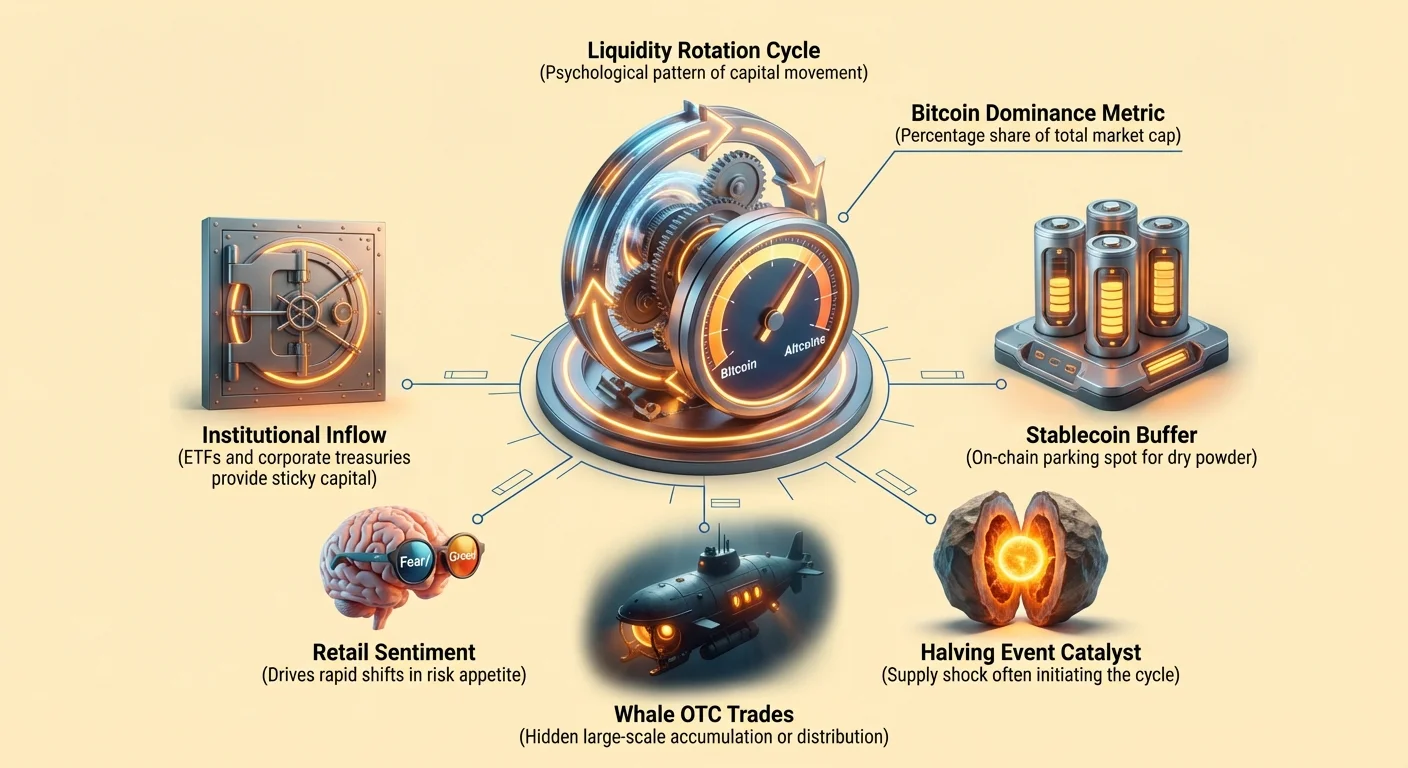
At the heart of this dynamic lies the concept of liquidity rotation. Money typically enters the cryptocurrency ecosystem through major gateways, primarily Bitcoin, due to its brand recognition, high liquidity, and perceived safety relative to other digital assets. As market confidence grows, this capital often diversifies into higher-risk assets in search of greater returns. Eventually, as risk sentiment sours, capital retreats back to the safety of Bitcoin or stablecoins.

The Metric of Market Control
Bitcoin dominance is one of the most critical metrics for gauging the state of capital flow in the digital asset space. It measures the percentage of the total cryptocurrency market capitalization that is comprised of Bitcoin alone. This figure provides a macroscopic view of Bitcoin's strength relative to the thousands of other assets in existence. Bitcoin dominance as a sentiment indicator.
Calculating Dominance
The formula for calculating Bitcoin dominance is straightforward yet powerful. It involves dividing Bitcoin's market capitalization by the total market capitalization of all cryptocurrencies combined. The resulting percentage offers a snapshot of market concentration. For example, if Bitcoin has a market cap of $500 billion and the total crypto market is valued at $1 trillion, the dominance stands at 50 percent.
This metric fluctuates based on the price performance of Bitcoin versus the aggregate performance of altcoins. It is important to note that dominance can decrease even if Bitcoin's price is rising, provided that altcoins are rising at a faster rate. Conversely, dominance can increase during a market crash if altcoins lose value more rapidly than Bitcoin.
Interpreting the Signals
Trends in Bitcoin dominance often signal shifts in investor sentiment. A rising dominance trend usually suggests a "risk-off" environment within the crypto sector. During these periods, investors may be liquidating risky altcoin positions and consolidating funds into Bitcoin, viewing it as a safer store of value during turbulent times. This often occurs during the early stages of a bull market or the depths of a bear market.
Conversely, a falling dominance trend often indicates a "risk-on" appetite. This phase suggests that investors are comfortable taking on higher risk to chase the potentially higher percentage gains offered by smaller-cap assets. When dominance drops significantly while the total market cap rises, it is frequently a hallmark of a phenomenon known as "altseason."
Bitcoin as the Capital Anchor
Bitcoin serves a unique role as the anchor of the digital asset economy. Launched in 2009, it established the benchmark for decentralized currency and remains the most widely recognized digital asset. Its fixed supply of 21 million coins and decentralized architecture position it differently from many altcoins, which may have flexible supplies or different governance structures.
Because of its longevity and liquidity, Bitcoin is often the first entry point for new capital entering the space. Institutional investors and retail newcomers typically acquire Bitcoin before exploring other assets. This initial inflow boosts Bitcoin's price and market cap, often causing dominance to spike in the early phases of a market cycle.
Comparison of key characteristics often drives these investment decisions:
| Feature | Bitcoin | Altcoins |
|---|---|---|
| Primary Purpose | Store of Value / Digital Money | DApps / DeFi / Governance / Utility |
| Supply Dynamics | Fixed (21 Million) | Varied (Fixed, Inflationary, or Unlimited) |
| Risk Profile | Lower Volatility (Relative) | Higher Volatility |
As the market matures, the narrative of Bitcoin as digital gold debate has strengthened. It is increasingly viewed as a hedge against inflation and a long-term store of value, distinct from the technological utility plays often associated with altcoins like Ethereum or Solana. This distinction is crucial for understanding why capital retreats to Bitcoin during periods of uncertainty.
The Phases of the Liquidity Cycle
The rotation of capital typically follows a predictable psychological pattern driven by profit-taking and risk tolerance. This cycle does not repeat perfectly, but the rhyme of liquidity movement remains consistent across historical market epochs.
The Bitcoin Inflow Phase
The cycle generally begins with a surge in Bitcoin price, often driven by external factors such as macroeconomic shifts or the intrinsic halving event. As Bitcoin price appreciates, it attracts media attention and fresh capital. During this phase, Bitcoin outperforms the majority of the market, and its dominance tends to trend upward. Investors focus on the market leader to capture the initial momentum while minimizing exposure to unproven assets.
The Wealth Effect and Dispersion
Once Bitcoin establishes a new high or enters a period of consolidation, early investors often find themselves sitting on significant unrealized profits. This creates a "wealth effect." Investors begin to look for opportunities to multiply their Bitcoin-denominated gains. Capital starts to bleed from Bitcoin into large-cap altcoins, which offer higher beta and the potential for outsized returns.
The Altcoin Frenzy and Retreat
As liquidity moves further down the risk curve, it flows into mid-cap and small-cap altcoins. This stage is characterized by rapid price appreciation in alternative assets and a sharp decline in Bitcoin dominance. However, this phase is typically unsustainable. Eventually, liquidity dries up, or market jitters return. Profits are then rotated back into Bitcoin for safety or into stablecoins to lock in dollar value, completing the cycle.
Institutional Influence on Capital Flows
The landscape of capital flow has evolved significantly with the entrance of institutional players. In the early years of crypto, market movements were dominated by retail traders. Today, entities such as public corporations and investment funds play a massive role in how money moves, often altering historical dominance patterns.
Corporate Treasuries
The concept of a Bitcoin corporate treasury involves companies holding Bitcoin on their balance sheets as a reserve asset. Firms like MicroStrategy and Tesla have adopted this strategy to hedge against fiat inflation and diversify their holdings. Unlike retail traders who might flip assets for quick profit, corporations often hold for the long term.
This behavior removes supply from the circulating market, potentially reducing volatility and creating a higher floor for Bitcoin dominance. When corporations buy, they typically do not rotate profits into altcoins. Their mandate is usually specific to Bitcoin due to its perceived regulatory clarity and store-of-value properties. This institutional "hodling" creates a capital sink that does not participate in the traditional rotation cycle. For more on this, see our guide on Bitcoin for corporate treasuries.
The Impact of ETFs
The approval and launch of Bitcoin Exchange-Traded Funds (ETFs) have opened a new conduit for capital. ETFs allow traditional investors to gain exposure to Bitcoin price action without managing private keys or wallets. This influx of capital is strictly bound to Bitcoin.
An investor buying a Bitcoin ETF is not setting up a crypto wallet to trade on decentralized exchanges. They cannot easily swap their ETF shares for a meme coin or a governance token. Therefore, capital entering through ETFs is "sticky" to Bitcoin. It does not naturally flow into the altcoin market in the same way native crypto capital does, potentially decoupling the traditional correlation between Bitcoin inflows and subsequent altcoin rallies.
Whales and OTC Trading Dynamics
Large-scale investors, known as whales, operate differently from the average retail participant. A whale is defined as an entity holding a significant amount of cryptocurrency, often enough to influence market prices with a single trade. Understanding how whales move capital is vital for analyzing dominance trends.
Over-The-Counter (OTC) Trading
Whales and institutions rarely execute massive buy or sell orders on public exchange order books. Doing so would cause "slippage," driving the price up while buying or down while selling, effectively resulting in a worse execution price. Instead, they utilize Over-The-Counter (OTC) trading desks.
OTC trading occurs directly between two parties, facilitated by a broker. These trades are private and do not immediately appear on public order books. Consequently, a massive inflow of capital via OTC might not immediately impact the visible Bitcoin price or dominance chart until the coins eventually move on-chain or public sentiment catches up. This hidden layer of capital flow adds complexity to dominance analysis, as the "smart money" often positions itself before the broader market detects the trend.
Accumulation and Distribution
Whales often engage in accumulation during market downturns when dominance is high and prices are low. They absorb liquidity from panic sellers. Conversely, during the height of a bull market, whales may distribute their holdings to retail investors who are chasing the rally. Monitoring on-chain data for whale wallet movements can provide early warning signs of capital rotation or impending volatility that standard price charts may miss.
Stablecoins: The Liquidity Buffer
The rise of stablecoins has fundamentally altered the mechanics of the crypto market cycle. In previous cycles, exiting a position often meant selling crypto for fiat currency and withdrawing to a bank account. This process was slow and removed liquidity from the crypto ecosystem entirely.
A New Parking Spot for Capital
Stablecoins, which are pegged to assets like the US dollar, allow investors to "cash out" without leaving the blockchain environment. When investors sell Bitcoin or altcoins, they often move into stablecoins like USDT or USDC to preserve capital while waiting for the next opportunity.
This liquidity remains on-chain, ready to be deployed back into Bitcoin or altcoins at a moment's notice. High stablecoin balances on exchanges or in smart contracts can represent "dry powder"—capital waiting on the sidelines. This dynamic accelerates the velocity of money within the ecosystem, as funds can rotate between Bitcoin, stablecoins, and altcoins instantly, shortening the duration of market cycles.
Volatility and Risk Management
Comparing the volatility profiles of Bitcoin and altcoins highlights why capital flows the way it does. Bitcoin, while volatile compared to traditional assets like gold or real estate, has historically shown less volatility than the majority of altcoins.
The Risk/Reward Trade-off
Altcoins generally have lower liquidity and smaller market caps, making them susceptible to wilder price swings. During bullish trends, this high beta allows them to outperform Bitcoin significantly. However, during bearish trends, they tend to crash much harder.
Investors managing risk often use Bitcoin as their baseline portfolio allocation. They may use a strategy like Dollar-Cost Averaging (DCA) to build a Bitcoin position over time. When they choose to enter the altcoin market, it is often a calculated move to capture alpha, with the intent of eventually rotating those profits back into the relative stability of Bitcoin.
This behavior reinforces the dominance cycle:
- Confidence builds in Bitcoin (Dominance Up).
- Risk appetite grows (Dominance Down, Alts Up).
- Fear returns or profits are taken (Dominance Up, Alts Down).
Market Cycles and the Halving
The entire mechanism of capital flow is heavily influenced by Bitcoin's four-year halving cycle. The halving is a pre-programmed event that reduces the reward for mining new blocks by 50 percent, effectively cutting the new supply of Bitcoin in half.
Historically, the halving has acted as a catalyst for the entire crypto market. The supply shock often leads to price appreciation for Bitcoin first. As the narrative of scarcity takes hold, the "digital gold" thesis is reinforced. This typically initiates the cycle of capital flow described earlier.
The reduction in new supply means that even if demand remains constant, the price should theoretically rise. If demand increases due to media coverage and FOMO (Fear Of Missing Out), the price moves can be dramatic. This primary impulse from Bitcoin eventually drags the rest of the market up with it, as the rising tide lifts all boats.
Bitcoin vs. Gold: The Macro Perspective
To understand capital flow into Bitcoin from the outside world, one must compare it to gold. Both assets are marketed as stores of value and hedges against inflation. However, their characteristics attract different types of capital.
Gold is heavy, difficult to transport, and requires physical storage or trusted custodians. It is a defensive asset with a multi-millennial track record. Bitcoin, often called digital gold, is highly portable, divisible, and verifiable on the blockchain. It appeals to a demographic looking for a high-growth store of value.
| Characteristic | Bitcoin | Gold |
|---|---|---|
| Verifiability | Mathematical (Blockchain) | Physical / Assay Required |
| Portability | High (Global, Digital) | Low (Heavy, Physical) |
| Scarcity | Absolute (21 Million) | Relative (Mining continues) |
As capital flows from traditional finance into crypto, it often treats Bitcoin as a modern alternative to gold. This macro-allocation view treats Bitcoin as a distinct asset class, separate from the "tech stock" behavior of many altcoins. This distinction further solidifies Bitcoin's role as the entry and exit point for major capital flows.
Conclusion
The dynamics of capital flow between Bitcoin and altcoins form the rhythmic heartbeat of the cryptocurrency market. By analyzing Bitcoin dominance, investors gain insight into the prevailing risk sentiment, whether capital is seeking the safety of the market leader or the potential gains of speculative assets. This dominance cycle is driven by a complex interplay of retail psychology, institutional accumulation, and macroeconomic factors.
As the ecosystem evolves with the introduction of ETFs, corporate treasuries, and sophisticated OTC trading, the patterns of the past may shift. Institutional capital tends to be stickier and more focused on Bitcoin, potentially altering the intensity of future "altseasons." However, the fundamental concept of liquidity rotation—from established safety to riskier speculation and back—remains a cornerstone of market behavior.
Successful navigation of crypto markets relies on recognizing that money flows in cycles, moving from the stability of Bitcoin to the volatility of altcoins and back again.