
The mechanics of liquidity provision stand as the central pillar of the modern cryptocurrency ecosystem. Without adequate liquidity, the seamless exchange of digital assets becomes impossible, leading to slippage, inefficiency, and market stagnation. Liquidity refers to the ease with which an asset can be converted into another asset or cash without affecting its market price. In the context of decentralized finance (DeFi) and broader crypto markets, liquidity is maintained by a complex network of platforms, protocols, and individual participants.
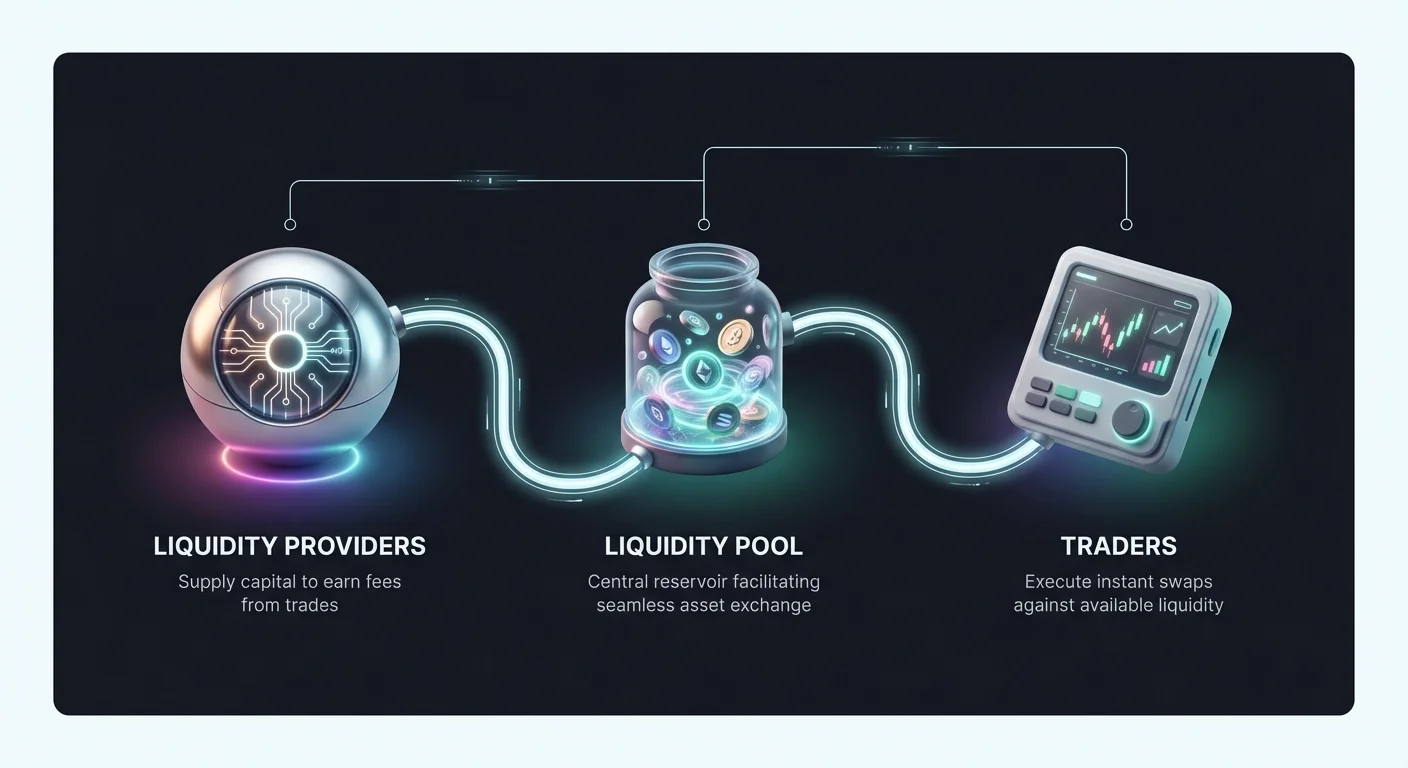
These participants, often called liquidity providers, supply the capital that facilitates trading for others. In return, they typically earn fees or interest, creating a symbiotic relationship between traders seeking execution and providers seeking yield. Understanding how these mechanisms function is essential for anyone looking to participate in the market, whether as an active trader or a passive earner.
The landscape of liquidity provision has evolved significantly. It began with traditional order book models on centralized exchanges. It has since expanded to include automated market makers (AMMs), peer-to-peer (P2P) swap protocols, and algorithmic grid trading strategies. Each method offers distinct advantages and carries specific risks.
This guide explores the operational mechanics behind these systems. It examines how swaps are executed, how automated strategies mitigate volatility, and how lending platforms utilize collateral to create liquidity. By dissecting these components, investors can better navigate the technical and financial realities of providing liquidity in the digital asset space.
The Fundamentals of Crypto Swaps and Exchange Mechanics
The most basic form of liquidity utilization occurs during a token swap. Unlike complex trading strategies that may involve derivatives or leverage, a swap is the direct exchange of one cryptocurrency for another. This process relies heavily on the underlying liquidity available on a platform to ensure the transaction settles instantly and at a predictable price.
Direct Asset Exchange Protocols
A crypto swap platform functions as a gateway for immediate asset conversion. These platforms differ from traditional trading interfaces by removing the complexity of order books, charts, and manual order matching. Instead, they offer a streamlined interface where a user inputs the amount of asset A they wish to sell, and the system calculates the amount of asset B they will receive.
Behind the scenes, the platform aggregates liquidity from various sources to fulfill this request. In non-custodial swap environments, the platform does not hold the user's funds. Instead, it facilitates a direct transfer between wallets or utilizes smart contracts to execute the trade. This reduces counterparty risk, as the user retains control of their private keys throughout the process.
Efficiency in this model is measured by the speed of settlement and the accuracy of the exchange rate. High-performance swap engines can complete transactions in minutes, utilizing deep liquidity pools to minimize the difference between the expected price and the final execution price. This difference, known as slippage, is a primary concern for liquidity providers and traders alike.
Comparing Centralized and Decentralized Execution
The execution of a swap varies significantly depending on whether it occurs on a centralized exchange (CEX) or a decentralized exchange (DEX). Centralized platforms act as intermediaries. They hold custody of assets and match buy and sell orders within their internal database. This allows for extremely fast execution speeds and high liquidity, as the platform aggregates orders from millions of users.
Decentralized exchanges operate on a different premise. They function without a central authority, relying on code and smart contracts to manage trades. Users trade directly with one another or against a liquidity pool. This enhances privacy and security, as funds are not stored on a central server that could be vulnerable to hacks. However, liquidity on DEXs can be fragmented, potentially leading to higher volatility in execution prices for large orders.
Hybrid exchanges attempt to merge these philosophies. They aim to offer the liquidity and speed of centralized systems while integrating the non-custodial security features of decentralized protocols. These platforms allow users to retain ownership of their funds until the moment of the trade, providing a balanced approach to liquidity access.
The Role of Liquidity Providers in Swaps
Every swap requires a counterparty. In traditional markets, this role is filled by professional market makers. In the crypto ecosystem, liquidity provision is often democratized. Individuals can deposit their assets into pools that facilitation swaps for others. When a trader executes a swap, they pay a small fee. This fee is distributed among the liquidity providers proportional to their share of the pool.
This mechanism transforms idle assets into productive capital. Instead of simply holding a token and hoping for price appreciation, an investor can contribute to the market's efficiency. However, this participation requires a deep understanding of the fee structures and potential risks involved. If the value of the pooled assets changes drastically, the provider may experience a phenomenon where their portfolio value is lower than if they had simply held the assets in a wallet.
Automated Market Strategies and Grid Trading
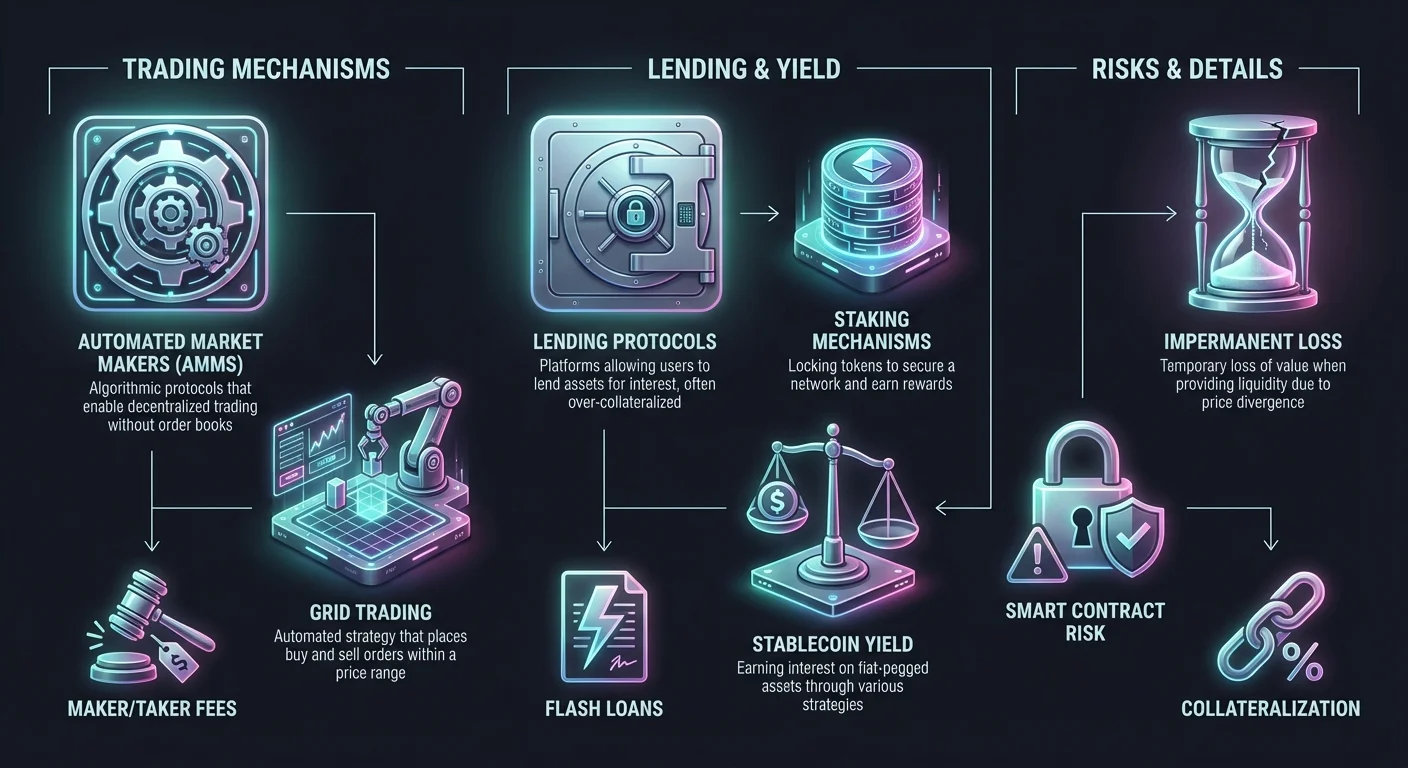
One of the most effective ways to provide liquidity and manage risk is through automated trading strategies. Grid trading is a prime example of a systematic approach that mimics the function of an Automated Market Maker (AMM) by creating a web of buy and sell orders across a specific price range.
Mechanics of Grid Trading Systems
Grid trading is an automated strategy designed to profit from market volatility. A trader or liquidity provider selects a price range for a specific asset and divides it into multiple levels, or "grids." The system then automatically places buy orders at lower levels and sell orders at higher levels. As the market price fluctuates within this range, the bot executes trades continuously.
When the price drops, the system buys the asset at pre-set intervals. When the price rises, it sells the accumulated assets at a profit. This continuous buying and selling provides liquidity to the market, as there are always open orders ready to be filled. For the user, it converts market volatility into a stream of small profits without requiring constant manual monitoring.
This strategy is particularly effective in sideways or ranging markets where the price bounces between support and resistance levels without establishing a strong trend. In such environments, a simple buy-and-hold strategy might yield zero returns, whereas a grid strategy can capture value from every small oscillation.
Mitigating Volatility Through Automation
Volatility is often viewed as a risk, but for liquidity providers using grid systems, it is the source of yield. By automating the response to price moves, grid trading removes the emotional component of investing. Human traders often panic during dips or become euphoric during rallies, leading to poor decision-making. Automated systems adhere strictly to the pre-defined logic.
Furthermore, grid trading acts as a form of impermanent loss mitigation. In a standard liquidity pool, if the price of one asset decouples significantly from the other, the provider ends up holding a large bag of the deprecating asset. Grid trading allows the user to define the specific range in which they are willing to trade. If the price exits this range, the system can be set to stop trading, limiting exposure to extreme market crashes or run-ups.
The customization of grid parameters allows for precise risk management. Users can adjust the grid spacing (the gap between orders) and the total number of grids. Narrow spacing executes more trades with smaller profits per trade, suitable for high-frequency scalping. Wider spacing executes fewer trades but captures larger price movements.
Application Across Asset Classes
While often associated with volatile cryptocurrencies, grid trading logic is versatile. It can be applied to stablecoin pairs (e.g., USDT/USDC) to capture minute fluctuations with minimal risk. It is also used in futures markets, where traders can apply leverage to their grid strategies.
Leveraged grid trading amplifies both the potential profits and the risks. By borrowing funds to increase the size of the grid orders, a trader can generate significant yield from relatively small price movements. However, this also introduces the risk of liquidation if the market moves sharply against the grid range.
For beginners, spot market grid trading is generally recommended. This involves trading with actual assets rather than derivatives, eliminating the risk of liquidation. The worst-case scenario in spot grid trading is holding a portfolio of assets that have decreased in value, rather than losing the entire principal due to a margin call.
Lending Protocols and Yield Generation
Liquidity provision is not limited to trading pairs. The lending market represents a massive sector of the crypto economy where liquidity is sourced from depositors and provided to borrowers. This mechanism mirrors traditional banking but operates with greater transparency and speed.
The Structure of Crypto Lending
Crypto lending platforms function as marketplaces for capital. Lenders deposit their digital assets into a pool, which is then made available to borrowers. In exchange for providing this liquidity, lenders earn interest. The interest rates are typically dynamic, determined by the supply of funds and the demand from borrowers.
Borrowers utilize these funds for various purposes, such as trading capital, arbitrage, or personal liquidity needs. Unlike traditional loans that rely on credit scores, crypto loans are almost exclusively secured by collateral. To borrow funds, a user must deposit a cryptocurrency asset that is worth more than the loan amount.
This over-collateralization ensures the solvency of the system. If a borrower defaults or the value of their collateral drops too low, the platform automatically sells the collateral to repay the lenders. This mechanism protects liquidity providers from bad debt and ensures that their principal is secure.
Collateralization and Loan-to-Value Ratios
The relationship between the loan amount and the collateral value is defined by the Loan-to-Value (LTV) ratio. For example, a platform might offer a 50% LTV. This means that to borrow $5,000, a user must deposit $10,000 worth of Bitcoin as collateral.
The LTV ratio acts as a risk management tool. Lower LTV ratios provide a larger safety buffer for lenders. If the market dips, there is significant room before the collateral value falls below the loan value. Higher LTV ratios allow borrowers to be more capital efficient but increase the risk of liquidation.
liquidation-explained in lending liquidity. If the market value of the collateral drops to a specific threshold (e.g., an LTV of 80%), a margin call is triggered. The borrower must add more collateral or repay part of the loan immediately. If they fail to do so, the protocol liquidates their assets. This automated enforcement of contract terms is what allows anonymous parties to transact with trust.
Unsecured and Flash Liquidity
While most crypto lending is collateralized, there are emerging markets for unsecured loans and specialized products like flash loans. Unsecured loans typically require rigorous identity verification and credit assessment, moving them closer to traditional finance (CeFi) models. These are less common in purely decentralized environments due to the difficulty of enforcing repayment without collateral.
Flash loans represent a unique form of liquidity provision possible only on blockchains. These are uncollateralized loans that must be borrowed and repaid within the same blockchain transaction block. If the funds are not returned by the end of the transaction, the entire loan is reversed as if it never happened.
Flash loans allow traders to perform instant arbitrage across different exchanges without needing to hold vast amounts of capital. For liquidity providers, flash loans offer a source of yield with zero default risk, as the protocol ensures the funds are returned or the transaction fails entirely.
Savings Accounts and Staking Mechanisms
For those seeking a more passive approach to liquidity provision, crypto savings accounts and staking offer viable pathways. These methods allow users to earn yield on idle assets, contributing to the stability and liquidity of the ecosystem without active management.
Centralized vs. Decentralized Savings
Crypto savings accounts are offered by both centralized platforms (CeFi) and decentralized protocols (DeFi). CeFi platforms operate similarly to banks. Users deposit funds, and the platform manages the lending and investment strategies to generate yield. These platforms often offer user-friendly interfaces and customer support, making them accessible to beginners.
However, CeFi savings accounts involve counterparty risk. The user must trust the platform to manage funds responsibly and remain solvent. In contrast, DeFi savings protocols use smart contracts to automate the lending process. Users deposit funds directly into a contract, which then routes the capital to borrowers or liquidity pools.
DeFi protocols often offer higher transparency, as all transactions and reserve levels are verifiable on the blockchain. Yet, they introduce smart contract risk. If the code governing the protocol contains a bug or vulnerability, it could be exploited, leading to a loss of funds.
Staking for Network Security and Liquidity
Staking is a distinct mechanism often conflated with savings. In Proof-of-Stake (PoS) blockchains like Ethereum or Solana, staking involves locking up tokens to support the network's security and transaction validation. Validators, who process transactions, are chosen based on the amount of stake they hold.
When users stake their tokens, they are effectively providing liquidity to the network's security layer. In return, they receive rewards in the form of newly minted tokens or transaction fees. This is a foundational form of liquidity provision that ensures the blockchain remains operational and secure against attacks.
Liquid staking is an evolution of this concept. In traditional staking, assets are locked and cannot be used. Liquid staking protocols issue a derivative token representing the staked asset. This allows users to earn staking rewards while still retaining a tradable token that can be used in other DeFi applications, significantly increasing capital efficiency.
Stablecoin Yield Strategies
A popular strategy for risk-averse liquidity providers is utilizing stablecoins. Stablecoins are cryptocurrencies pegged to the value of fiat currencies like the US Dollar. By depositing stablecoins into savings accounts or lending pools, users can earn interest without exposure to the price volatility of assets like Bitcoin or Ethereum.
Interest rates on stablecoins are typically higher than traditional fiat savings accounts. This is due to the high demand for stablecoin liquidity in the crypto market. Traders need stablecoins to enter and exit positions, and borrowers need them for leverage. This structural demand drives yield for providers who are willing to supply stable, dollar-pegged liquidity.
Exchange Types and Fee Structures
The venue where liquidity is provided dictates the fee structure and the potential profitability for the provider. Understanding the nuances between different exchange types is crucial for optimizing returns.
Maker vs. Taker Dynamics
In almost every trading environment, fees are divided into two categories: maker fees and taker fees. Makers are the liquidity providers. They place limit orders that sit on the order book, waiting to be filled. By doing so, they "make" the market, adding depth and stability.
Takers are the traders who demand immediate liquidity. They place market orders that are filled immediately against the existing orders on the book. Takers "take" liquidity away from the market. Because liquidity is valuable, exchanges typically charge takers higher fees and offer makers lower fees.
In some advanced trading ecosystems, makers may pay zero fees or even receive a rebate. This negative fee structure effectively pays the user to provide liquidity. For professional market makers and algorithmic traders, capturing these rebates is a primary source of revenue.
Zero-Fee Trading Models
Some exchanges have adopted zero-fee trading models to attract users. In these scenarios, the platform may waive fees on specific pairs or for spot trading. While this benefits the trader, it changes the incentives for liquidity providers.
On zero-fee platforms, the exchange must generate revenue through other means, such as wider spreads or interest on margin trading. For a liquidity provider, a zero-fee environment might mean there are no direct trading fees to earn. However, these platforms often have high volume, which can be beneficial for strategies that rely on capturing the spread between the buy and sell price.
It is important to analyze the true cost of "zero-fee" structures. Often, the cost is hidden in the spread or in withdrawal fees. Providers must calculate whether the volume and spread capture justify the capital deployment in the absence of explicit fee revenue.
Hybrid and Derivative Exchanges
Hybrid exchanges offer a blend of centralized speed and decentralized security. For liquidity providers, these platforms can offer unique opportunities. They may allow for non-custodial liquidity provision while maintaining a high-performance order book that attracts institutional traders.
crypto-derivatives-mechanics-use-cases, which facilitate futures and options trading, require massive amounts of liquidity. These platforms allow traders to speculate on price movements without holding the underlying asset. Liquidity providers on derivatives platforms act as the counterparty to these leveraged positions.
The risk profile on derivatives exchanges is higher. Providers must manage the exposure to leveraged positions and the potential for rapid market moves that can cascade into mass liquidations. However, the fees generated from leveraged trading volume are often significantly higher than spot markets, offering a risk premium to sophisticated providers.
Risk Management and Security Considerations
Participating in DeFi liquidity provision and utilizing crypto exchanges involves navigating a complex landscape of risks. From technical vulnerabilities to market dynamics, providers must implement robust mitigation strategies to preserve their capital.
Impermanent Loss and Volatility
Impermanent loss is a primary risk for liquidity providers in AMMs. It occurs when the price of the deposited assets diverges from the price at which they were deposited. Due to the mathematical formula used by AMMs to maintain liquidity, the provider may end up with a greater quantity of the less valuable asset and a smaller quantity of the more valuable one.
The loss is termed "impermanent" because if the prices return to their original state, the loss disappears. However, if the provider withdraws their liquidity while the prices are divergent, the loss becomes permanent. To mitigate this, providers often choose pairs with high correlation (like two stablecoins) or utilize hedging strategies.
Grid trading acts as a functional hedge against this type of volatility. By actively buying low and selling high within a range, the strategy realizes profits along the curve, effectively locking in gains that might otherwise be lost to impermanent loss in a passive pool.
Platform Security and Custody
The security of the platform itself is paramount. Centralized exchanges hold user funds in custodial wallets. If the exchange is hacked, user funds are at risk. To mitigate this, top-tier platforms employ cold storage, where the vast majority of assets are kept offline in hardware wallets, inaccessible to internet-based attacks.
Two-factor authentication (2FA) is a critical user-side security measure. It requires a second form of verification, such as a code from a mobile app, to authorize withdrawals. This prevents unauthorized access even if a password is compromised.
In decentralized protocols, security audits are the equivalent of cold storage. Reputable protocols undergo rigorous code reviews by third-party security firms to identify vulnerabilities. Users should verify that any protocol they interact with has been audited and has a bug bounty program in place to incentivize white-hat hackers to report issues rather than exploit them.
Regulatory and Compliance Risks
The regulatory environment for crypto is constantly shifting. Platforms that are compliant today may face new rules tomorrow. This is particularly relevant for lending and savings products, which often draw scrutiny from financial regulators.
Users should be aware of the jurisdiction in which a platform operates. Regulated platforms typically have stricter identity verification (KYC) processes but offer greater legal protections. Unregulated or anonymous platforms offer more privacy but little recourse in the event of a dispute or closure.
Compliance also impacts taxation. In many jurisdictions, every swap, trade, or interest payment is a taxable event. Liquidity providers must maintain detailed records of their transactions to ensure they can accurately report their earnings and avoid penalties. Many platforms now provide tax reporting tools to assist with this compliance burden.
| Risk Type | Description | Mitigation Strategy |
|---|---|---|
| Impermanent Loss | Asset divergence causes value drop | Trade correlated pairs or use Grid Trading |
| Platform Hack | Loss of funds due to security breach | Use Cold Storage, 2FA, and Hardware Wallets |
| Liquidation | Collateral sold due to price drop | Maintain conservative LTV ratios |
Navigating Payment Methods and Accessibility
For liquidity providers to operate effectively, they need efficient on-ramps and off-ramps for their capital. The accessibility of a platform and the variety of payment methods supported play a significant role in the overall user experience.
Funding and Withdrawal Options
The ability to move fiat currency into and out of the crypto ecosystem is often the first hurdle. Top exchanges support a wide array of payment methods, including bank transfers, credit cards, and digital wallets like PayPal. Bank transfers are typically the most cost-effective for large sums, although they may take several days to settle.
Credit and debit cards offer instant settlement but usually come with high processing fees. These fees directly eat into the potential yield of a liquidity provision strategy. Therefore, providers often prefer bank wires or P2P marketplaces where they can negotiate rates directly with other users.
Withdrawal limitations are another factor. Some platforms impose daily or monthly limits on how much capital can be removed. For large liquidity providers, these limits can be restrictive. Verifying account tiers and withdrawal policies before committing capital is essential to avoid liquidity traps where funds are accessible but not withdrawable.
Global Accessibility and Restrictions
Crypto is a global market, but access is not uniform. Local regulations often restrict specific services in certain countries. For instance, derivatives trading or high-yield lending products may be banned in jurisdictions with strict financial controls.
Platforms often use geo-blocking to comply with these laws. A user in the United States might see a different interface and feature set than a user in Asia. Using a VPN to bypass these restrictions can violate the platform's terms of service and result in account freezing.
Language support and localized customer service are also indicators of a platform's accessibility. The best platforms offer multilingual support and interface options, ensuring that users can navigate complex financial terms in their native language. This reduces the risk of errors caused by misunderstanding platform mechanics.
Conclusion
The mechanisms of DeFi liquidity provision offer a diverse array of opportunities for capital generation and market participation. From the simplicity of stablecoin savings accounts to the complexity of algorithmic grid trading, there is a strategy available for every risk appetite. Understanding the underlying mechanics—how swaps are routed, how yields are generated, and how fees are distributed—is the first step toward successful engagement.
However, these opportunities are inseparable from their risks. Volatility, impermanent loss, and platform security remain constant challenges that require vigilance and disciplined risk management. The transition from a passive holder to an active liquidity provider demands a shift in mindset, prioritizing preservation of capital alongside the pursuit of yield. By utilizing robust platforms, employing automated strategies like grid trading, and maintaining strict security protocols, participants can effectively navigate this dynamic landscape.
True liquidity is not just about volume, but the resilience of your strategy against market volatility.